

Ausculo: Designing Trust into Telemedicine
A UI/UX Case Study for Rural Healthcare in India
.jpeg)
Summary
I led the UI/UX design for Ausculo, a digital stethoscope built to bridge the diagnostic access gap in rural India by supporting Community Health Officers and remote doctors. I designed the accompanying application to work in low-resource environments, streamlining communication and patient data sharing so that remote consultations can be trusted.
Product
- iOS
- Android
- Web
- Desktop
Team
- Prof. Monika Aggarwal (CARE, IIT Delhi)
- Prof. Mohammed Naim Shaikh (NID)
- Nikhil Yogi, Abhishek Ranakoti & Saiyad Mohammad Afzal
Impact
- Design direction validated by Dr. Sanjay Sood (eSanjeevani) and Dr. Desh Deepak (RML Hospital)
- Steered engineering away from three unviable paths: an ASHA-operated device, a standalone AI diagnosis, a new telemedicine platform
- Field research across 6 locations in Himachal Pradesh and 10+ stakeholder interviews
- Published at HFES 2025; 40+ high-fidelity screens handed off
Context
What is telemedicine?
Many patients in rural India travel hundreds of kilometres for a basic consultation. Telemedicine is meant to close that distance. The government's eSanjeevani platform connects a rural patient to a doctor in a city.
Problem with telemedicine?
A call loses the physical examination, the step a doctor diagnoses much from. Without it, a teleconsultation is a conversation about symptoms. That is not enough for COPD, pneumonia, a heart murmur or an arrhythmia.
Why a digital stethoscope?
It records heart and lung sounds at the village end, so a doctor 200 kilometres away can listen to what they could not examine. Auscultation is one of the easiest ways to give a doctor basic information about the inside of the body, without being invasive.
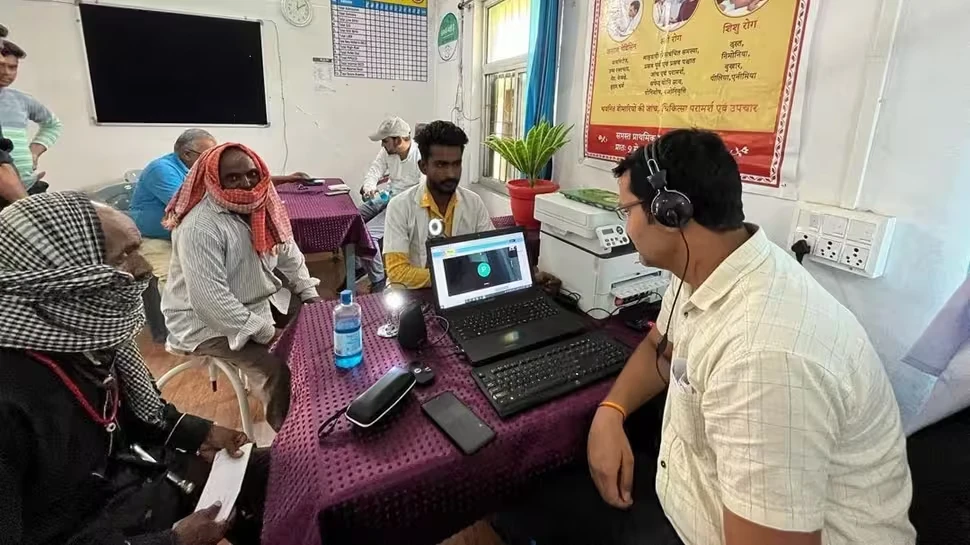
A teleconsultation at a health centre.
How a doctor reaches a diagnosis
The goal
Design a digital stethoscope and a supporting app that let a health worker record chest sounds and send them to a remote doctor for diagnosis.
What we'll track
Diagnostic confidence
Target: 4 out of 5
Task completion
Target: 90% and up
Adoption intent
Target: 4 out of 5
Usability (SUS)
Target: 74 or above
Ripping the brief
What I was given
CARE, IIT Delhi gave me a working hardware prototype and a one-line brief. It was the device only: a printed housing, two circuit boards, two piezoelectric sensors, a battery and a DAC board. There was no application at all.
What I did with it
I broke the brief apart and highlighted every assumption in it. Each highlighted phrase hid questions, and I sorted them into three areas: the stethoscope, telemedicine, and the people it was for.
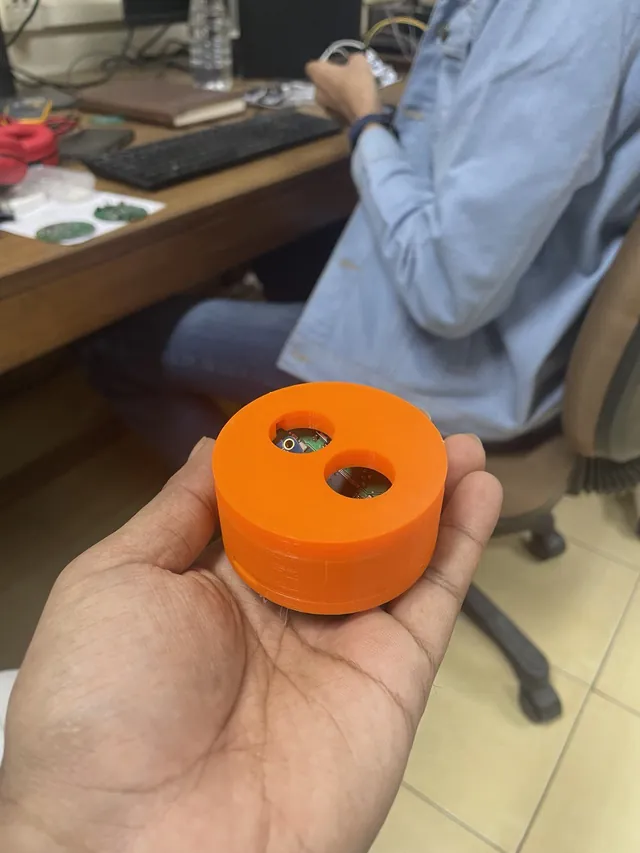
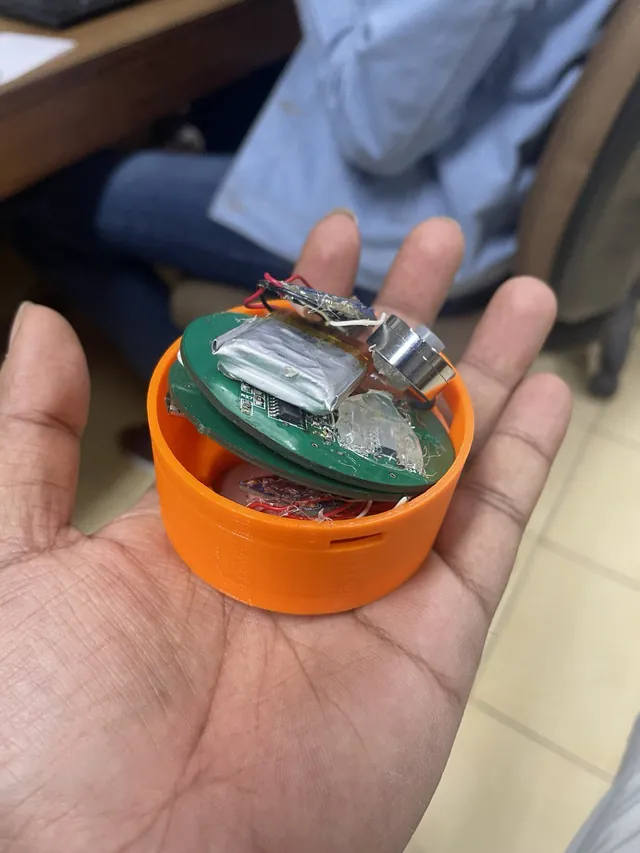
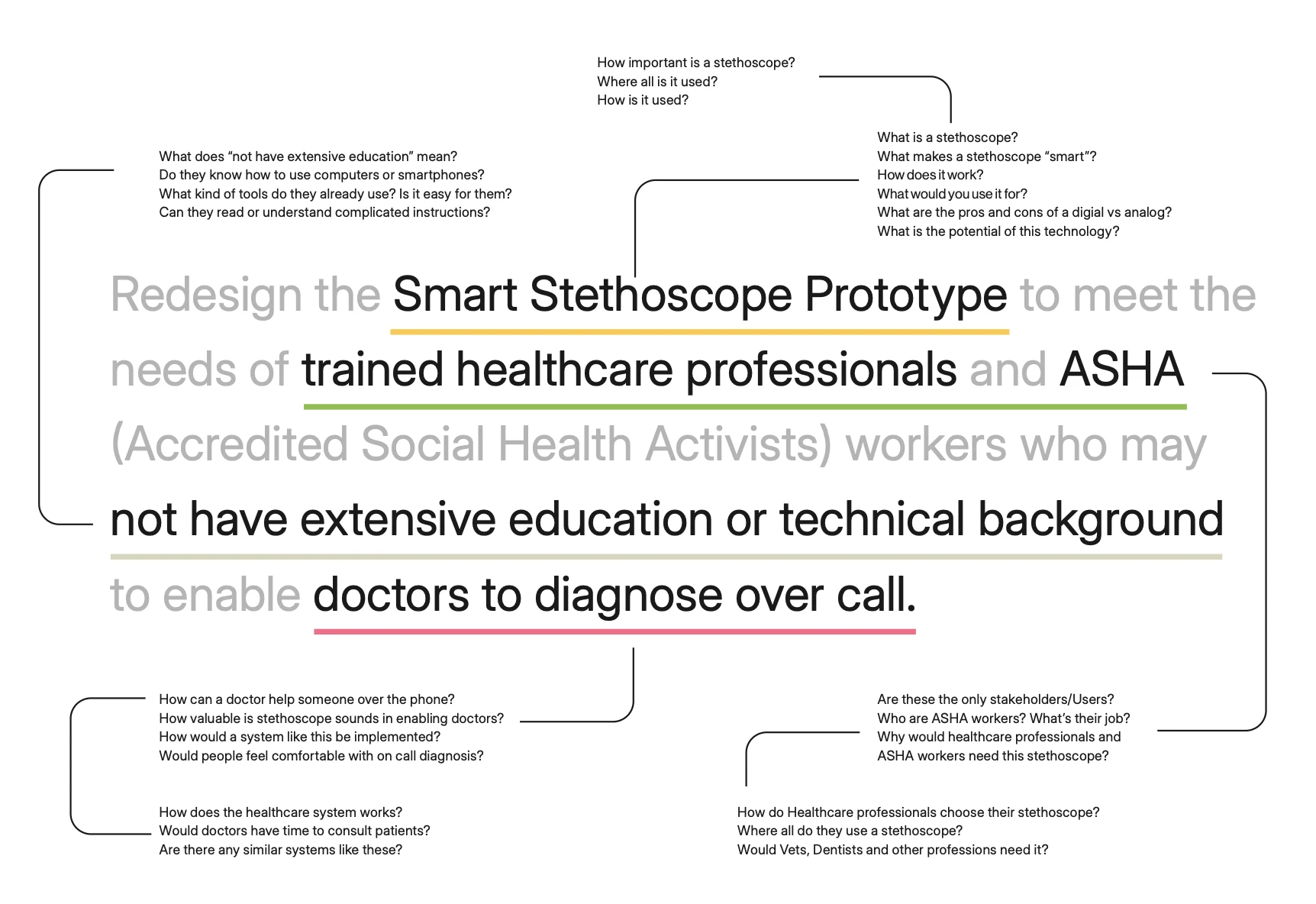
Every highlighted phrase hid questions. I sorted them into the stethoscope, telemedicine, and the people it was for.
Research
Secondary research
Desk research on the three areas the brief raised: the stethoscope, telemedicine, and the people. I then narrowed the brief: what the stethoscope would cost, and whether to design for students and doctors too.
The stethoscope
Doctors were not the ones buying them.
What it changed: cost, battery and noise were what stopped people, not features. The device had to be affordable and trusted, and earn its place against brand loyalty.
The stethoscope
Doctors were not the ones buying them.
What it changed: cost, battery and noise were what stopped people, not features. The device had to be affordable and trusted, and earn its place against brand loyalty.
Shop reviews were generic. The useful ones were on Reddit, Twitter, LinkedIn and YouTube, where clinicians and students talk openly.
What people praised
- Noise cancelling, for vets and military medics
- A link to hearing aids
- Recording sounds for teaching
- Reusable AAA batteries
- Trust in the Littmann name
What put them off
- Cost, above all for students
- Battery drain, even from switching on in a pocket
- Background noise that is hard to filter
- A sense that the tech is unnecessary
Who buys: people with a hearing disability, students who want to record, hobbyists, and anyone drawn to AI tools, seeing the sounds, or wireless earphones. Who doesn’t: those put off by price or battery.
What they cost
- Ausculo (target)₹6,000 to ₹10,000
- AyuLynk₹12,500
- Littmann CORE₹27,543
- Eko CORE 500₹33,403
- AyuSynk 2Pro₹34,990
- Thinklabs₹58,990
Telemedicine
Healthcare by call is old. What it misses is not.
What it changed: the objection to telemedicine, that a doctor cannot hear or feel what is wrong, is exactly what a digital stethoscope can answer. That is where this project sits.
Telemedicine
Healthcare by call is old. What it misses is not.
What it changed: the objection to telemedicine, that a doctor cannot hear or feel what is wrong, is exactly what a digital stethoscope can answer. That is where this project sits.
1876
Bell’s telephone
The first call for help
Radio era
Radio to ships
Medical advice at sea
1960s
NASA telemetry
The first telemedicine clinic
2020
COVID-19
Care by call becomes routine
What people say it does well
- Eases the load on hospitals
- Spares very sick patients the journey
- Saves cost
- Reaches rural areas
What people say it misses
- Subtle signs found by touch or listening
- Face-to-face contact
- Software and training barriers in rural areas
The people
None of the three is trained to listen to a chest.
What it showed: ASHAs, ANMs and Anganwadi workers each have a clear role, and diagnosis by listening is not part of any of them.
The people
None of the three is trained to listen to a chest.
What it showed: ASHAs, ANMs and Anganwadi workers each have a clear role, and diagnosis by listening is not part of any of them.
ASHA
A woman from the village, 25 to 45, chosen by her community. Maternal and child health, TB, sanitation, first aid.
Auscultation is not part of basic training.
ANM
Formally trained nurse-midwife who runs a sub-centre and supervises ASHAs. Thermometer, MUAC tape, BP, scales.
Stethoscope mostly for blood pressure. Refers anything complex.
Anganwadi worker
Runs nutrition and pre-school for the child development scheme. 32 days of training, then 7 days every two years.
Not a diagnosis role.
Where each one sits
- District hospital · about 2 million people
- Community health centre · 80,000 to 120,000
- Primary health centre · 3,000 to 30,000
- Sub-centre, run by an ANM · 3,000 to 5,000
- ASHA · 300 to 1,000
Primary research
The secondary research left some questions unanswered, and there was far more of it than I could cover in the time. I reached out to people who could help me focus. It was still discovery: I was not asking specific questions, just trying to see what I was dealing with.
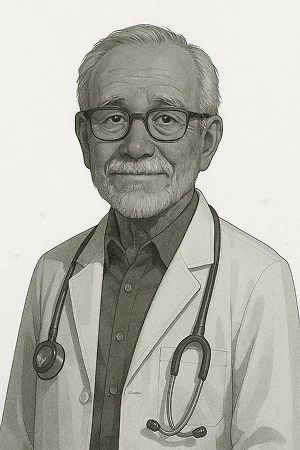
Doctors
Loyal to their analog stethoscope; one owned a Littmann CORE and rarely used it. The barrier was habit, not features.
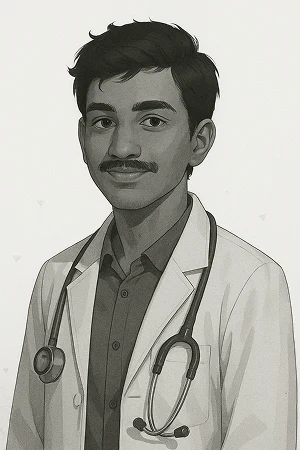
Medical students
Learning sounds from YouTube on ₹1,200 to ₹2,000 models. The most receptive group: recording, slow playback and sharing with seniors all had immediate value.
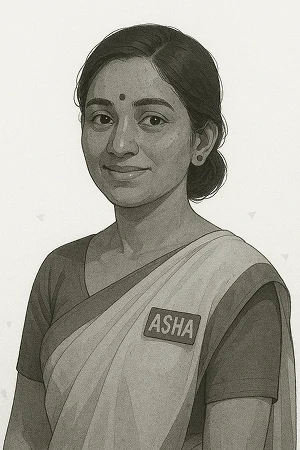
ASHA workers
Their method is symptom recognition and referral, not listening. Many did not own a smartphone before the pandemic.
Telemedicine companies
I reached out to six, looking for a platform to plug into. None replied.
Gaps in the brief?
Critical problemThe brief was wrong about its users. ASHA workers did not have the training, and they were not part of a system that could fill these gaps. With no system in place, I also did not know who would be diagnosing: which doctor would it be? The brief had become about redesigning a stethoscope for the sake of it. Nobody I spoke to could fill in these blanks.
Redesign the Smart Stethoscope Prototype for 1, connected to 2, so that 3 can diagnose over call.
- 1Who is the user? Was: ASHAs, ANMs and Anganwadi workers
- 2Which system does it plug into? Nobody I spoke to could name one
- 3Who is listening on the other end? Not even the doctor who suggested the idea could say
The only thing that made sense was four use cases that Dr. Desh Deepak helped me formulate.
Screening
ASHA workers checking many people at once for COVID or other problems.
Diagnosis
Doctors and students using it themselves, with AI to help with accuracy.
Education
Students using the recordings to improve their skill.
Monitoring
A home telemedicine kit, so fewer visits to a doctor are needed.
Reframe
- 1The blanks
- 2Four strategies
- 3The reply
- 4The new brief
The question
The research left three blanks. I tried to fill them myself.
- Who is the user?
- What does it plug into?
- Who diagnoses on the other end?
Four strategies before I got the answer
| Strategy | Who is the user? | What does it plug into? | Who diagnoses? | How it ended |
|---|---|---|---|---|
Design for ASHA workers anyway | ASHA workers | Nothing. No system existed where ASHAs were in use. | A doctor, or AI | Nothing to plug into. |
AI inside the stethoscope | Anyone, even untrained | Nothing. The device stands alone. | The AI, with no doctor on the line | Needs clinical validation and approval, with misdiagnosis liability. |
A telemedicine kit for the home | Patients themselves | Not worked out | A doctor, from the recordings | Every home needs a kit. Too expensive. |
A custom platform connecting ASHAs with doctors | ASHA workers, patients, and doctors and students | My own platform. I would build it. | A doctor, or AI | The one I went forward with. |
The reply that changed the brief
Then the Project Director of eSanjeevani replied. He had everything I was looking for, and he answered all three blanks.
The original brief grouped ASHAs, ANMs, and CHOs together. Research showed ASHAs lacked auscultation training. ANMs tested very well and were highly capable, but were already overburdened with maternal/infant care duties. We pivoted the product exclusively to CHOs (Community Health Officers) because they are the designated operators of the eSanjeevani telemedicine network at Health & Wellness Centres.
Screening did not disappear either. CHOs already run camps where many people come and everyone is tested.
The user: CHOs and MLHPs. Not ASHA workers.
The system: eSanjeevani. What I was trying to invent already existed.
The listener: A doctor at a hub hospital.
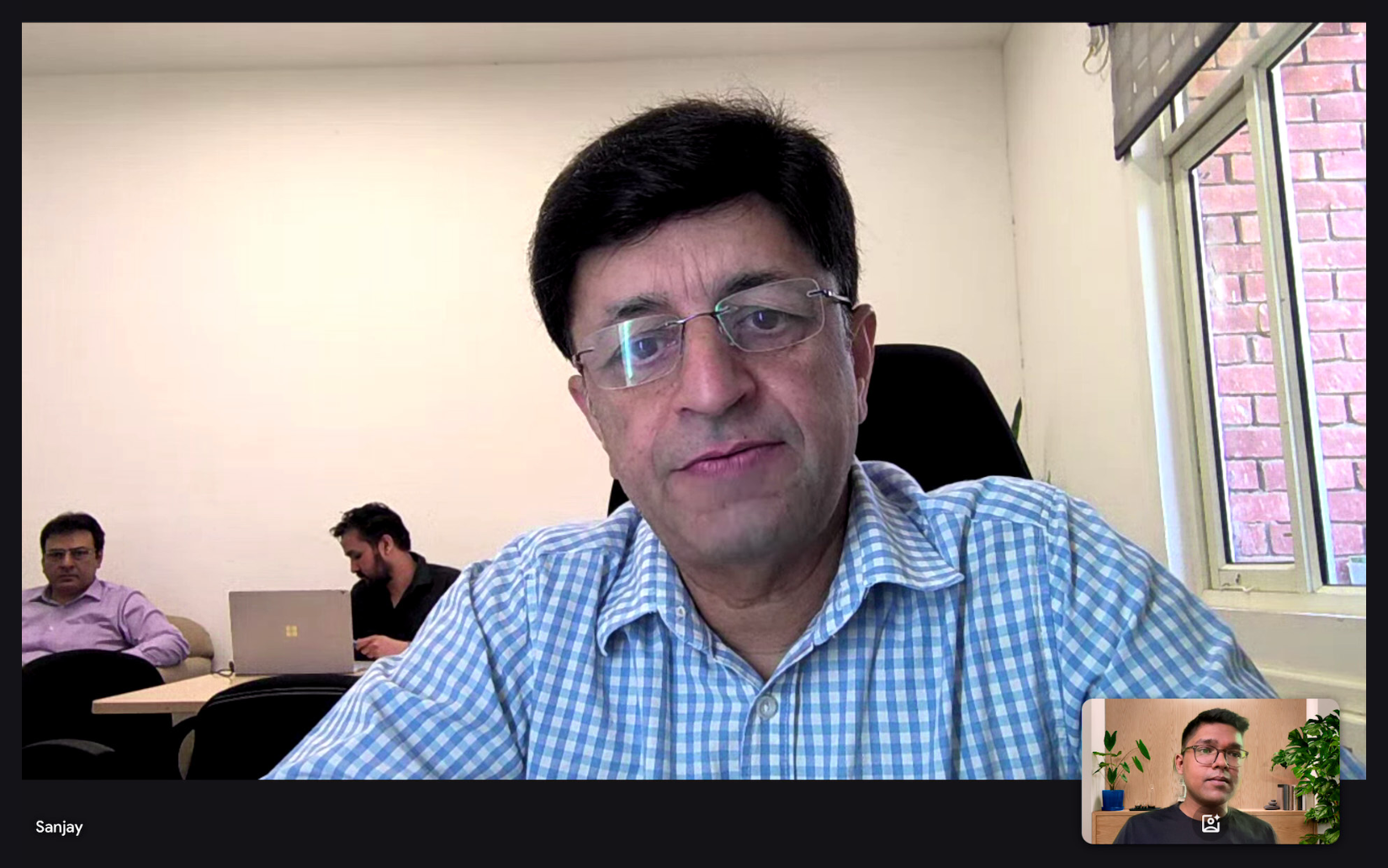
The eSanjeevani portal any device would have to live inside.
The old brief
Redesign the Smart Stethoscope Prototype to meet the needs of trained healthcare professionals and ASHA workers who may not have extensive education or technical background to enable doctors to diagnose over call.
The new brief
Redesign the Smart Stethoscope Prototype for CHOs and MLHPs, connected to eSanjeevani, so that a hub doctor can diagnose over call.
What changed
Who is the user?
CHOs and MLHPs
What does it plug into?
eSanjeevani
Who diagnoses?
A hub doctor
Who else?
Students, for long-term adoption
Research 2.0
With the user and the system clear, I went back to research. This time I wanted to learn what a stethoscope helps a doctor hear, what already exists, how it is built, and how other apps in this space work.
Ideation
What should the app do, and for whom?
01
Prioritise the features
We decided which features we want to prioritise.
02
Draw the user flows
Based on those features, we created user flows.
03
Wireframe on big sheets
We started wireframing these on big sheets, trying to see what different iterations we could go for.
04
Rough drafts, then low-fi prototypes
Once we had nailed it down, we drew the final wireframes as rough drafts, then made low-fidelity prototypes of those screens.
Prototype
The first MVP was a low-fidelity prototype, rough on purpose: grey boxes and plain buttons, so people react to the flow and not the styling. Step through one consultation and try each screen.
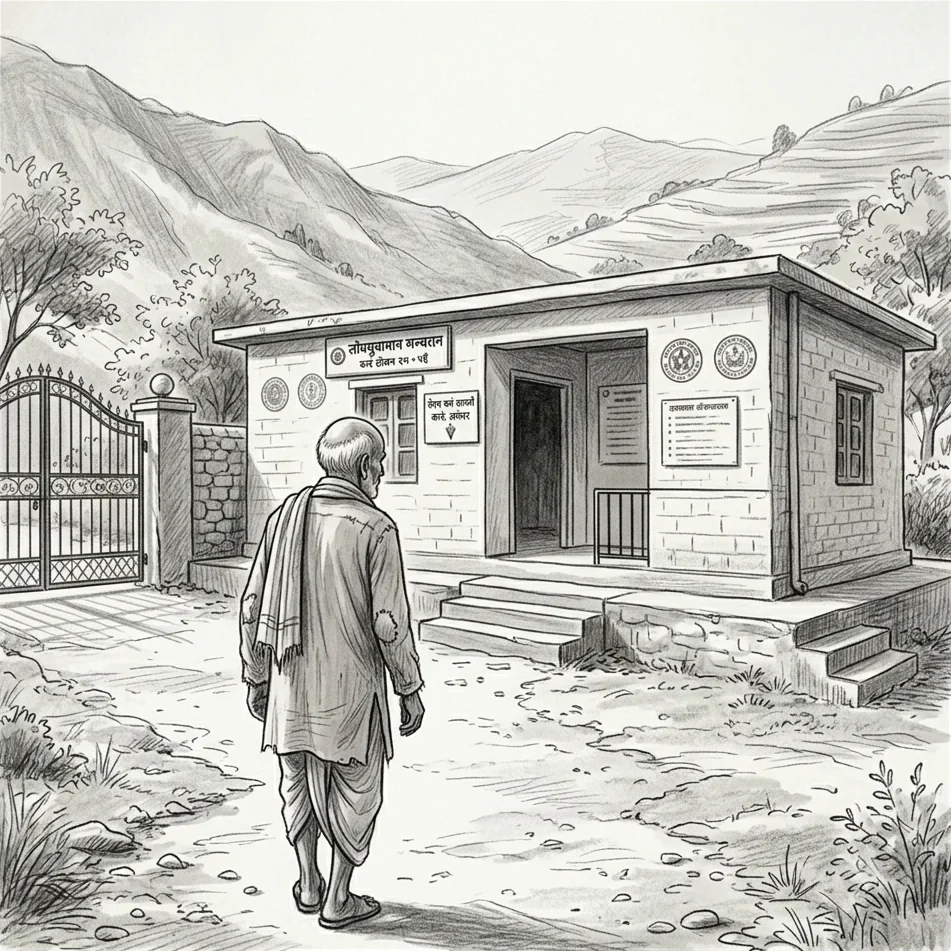
A patient walks into the sub-centre.
No screen yet. The story starts at the nearest centre, not a city hospital.
Field testing
Would it work in a real clinic?
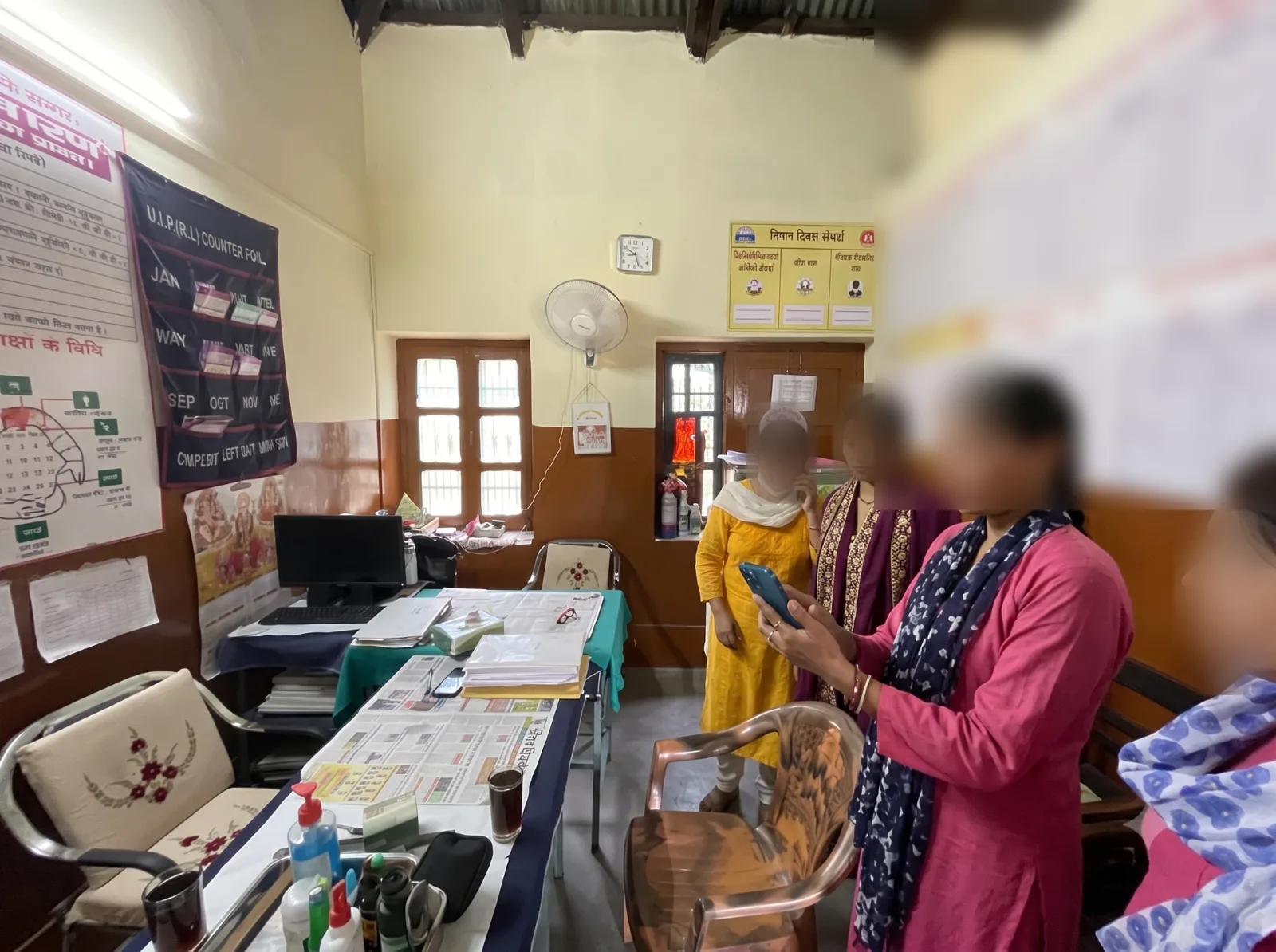
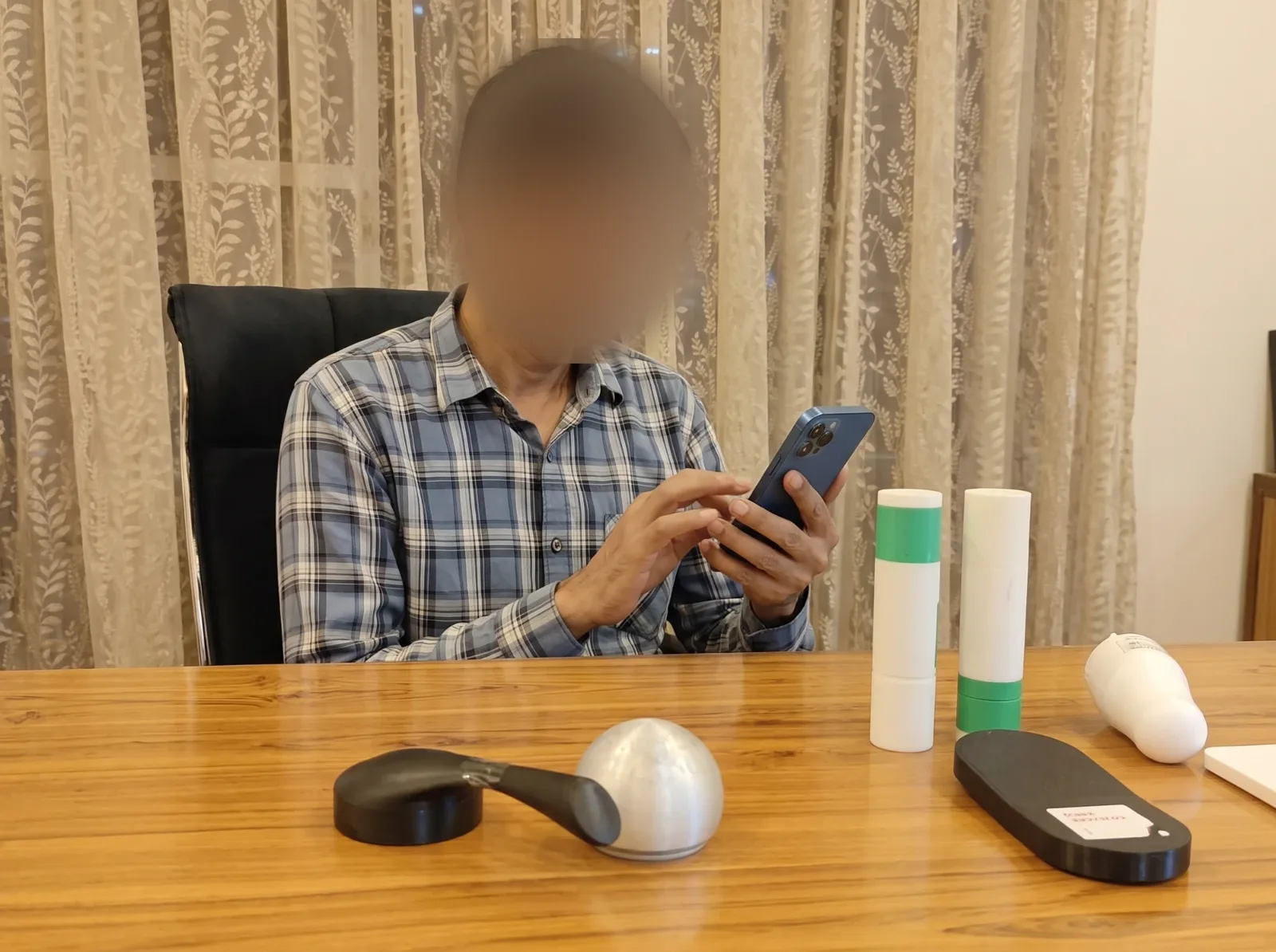
Who and where
37 people
18 in the first round (medical students, residents, government and private doctors), then 10 CHOs, 4 ANMs and 5 doctors, in Delhi and Dharamshala.
Methodology
Moderated walkthrough
Tasks for each role, thinking aloud. I noted where people hesitated or asked for help.
Scoring system
SUS, out of 100
A short usability questionnaire. Mean 77.1 from six people (2 CHOs, 2 ANMs, 2 doctors), against a benchmark of 68.
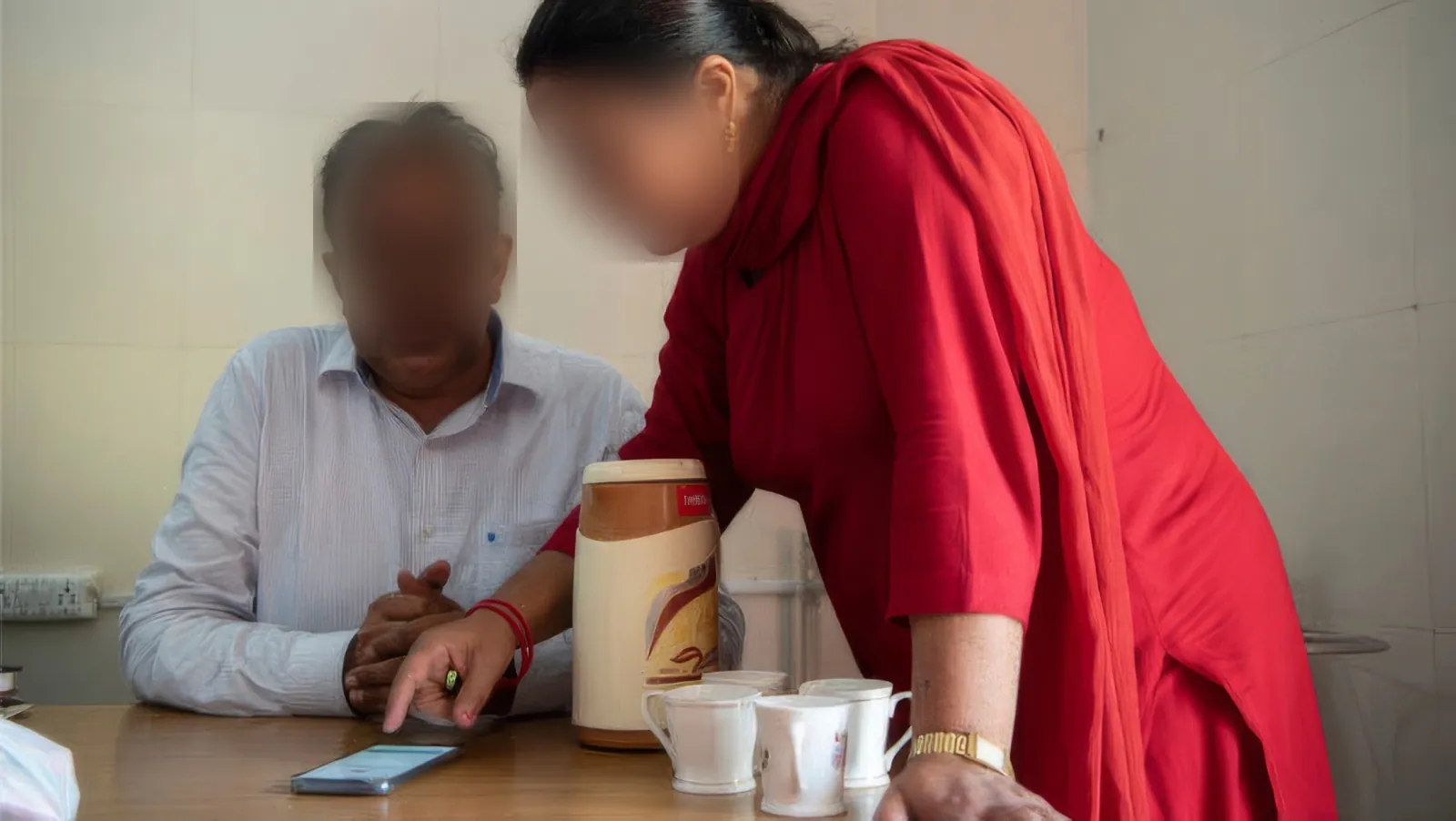
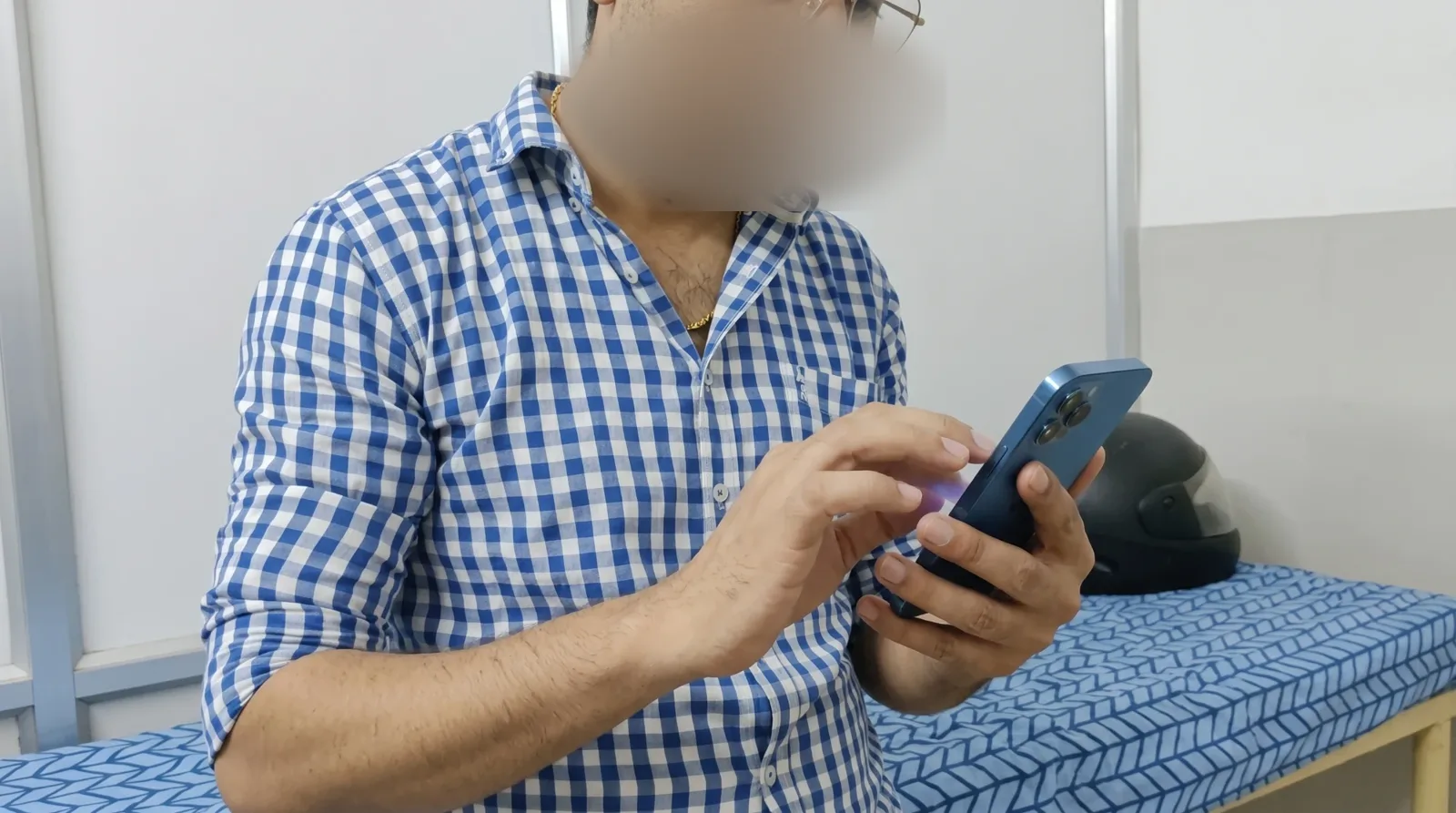
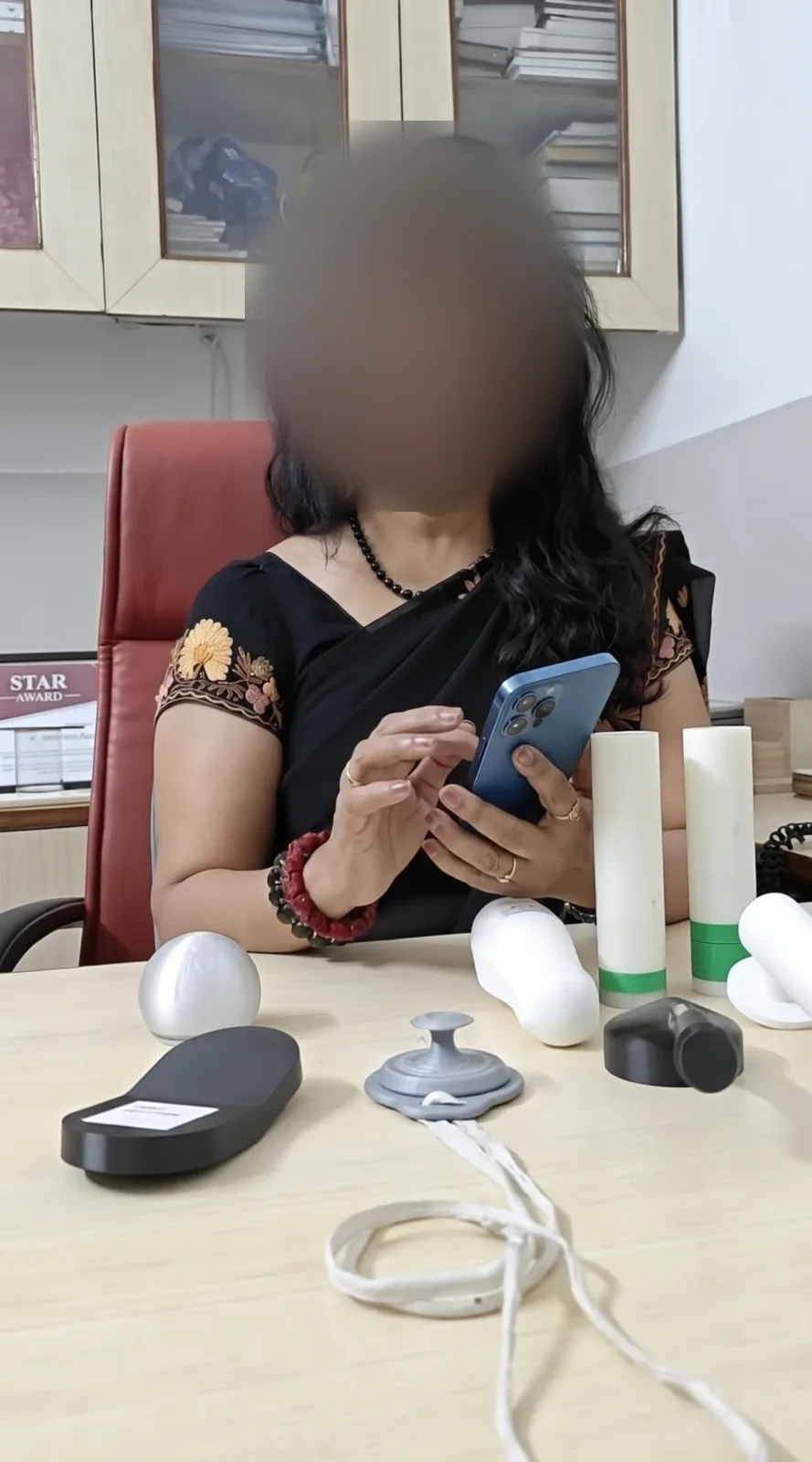
Feedback
- Smooth
- Friction
- Blocked
Power, audio and network
- 1
Battery life was a problem; wanted AA batteries, and wired audio over Bluetooth
Device setup·Led to: AA batteries and wired audio
- 5
No network, no consult; wanted an audio-call option
Remote integration
- 6
Sound cues unclear in a noisy room
Handling errors·Led to: A ring of coloured light
Knowing where and when
- 2
Position was only a text field on the phone; needed it shown
Positioning·Led to: A body map the CHO taps
- 3
On the phone, unsure when the AI would step in; asked for Hindi
Device and app use·Led to: An AI report, created on request
Sharing
- 4
Wanted a way to send things, especially on WhatsApp, which was not integrated at first
Data management·Led to: Share by link or WhatsApp
What worked
The visual guidance on where to place the stethoscope helped a lot
Positioning
Switching language was easy
Device setup
The UI was simple enough, and they liked the prototypes in general
Device and app use
Sure that a little training would get them used to it
Training
Loved Academy: it would help them understand different sounds
Self-learning
Metrics
Task completion
Target: 90% and up
~85%
85%With light guidance. Stalled at the AI trigger and at ABHA linking.
Diagnostic confidence
Target: 4 out of 5
3.2 / 5
64%Using it alone: unsure when the AI steps in, and sound cues unclear in noise.
Adoption intent
Target: 4 out of 5
4.2 / 5
84%Their complaints were fixes, not rejections.
Usability (SUS)
Target: 74 or above
76
76%Two CHOs (80, 67.5) and two ANMs (82.5, 75). Easy to use; the lowest score came from relying on another person.
What I found
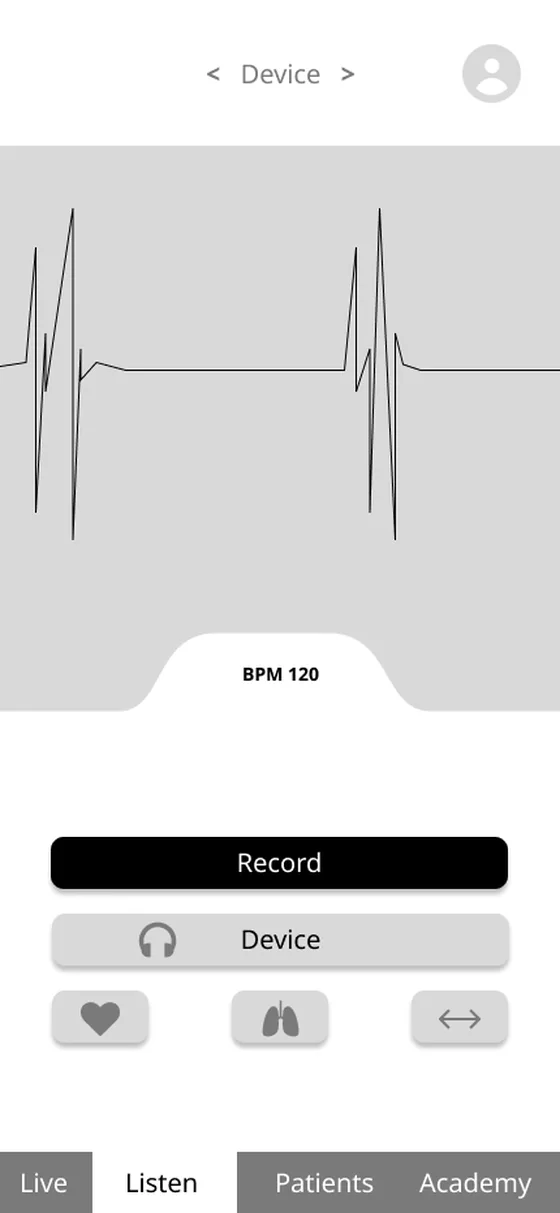
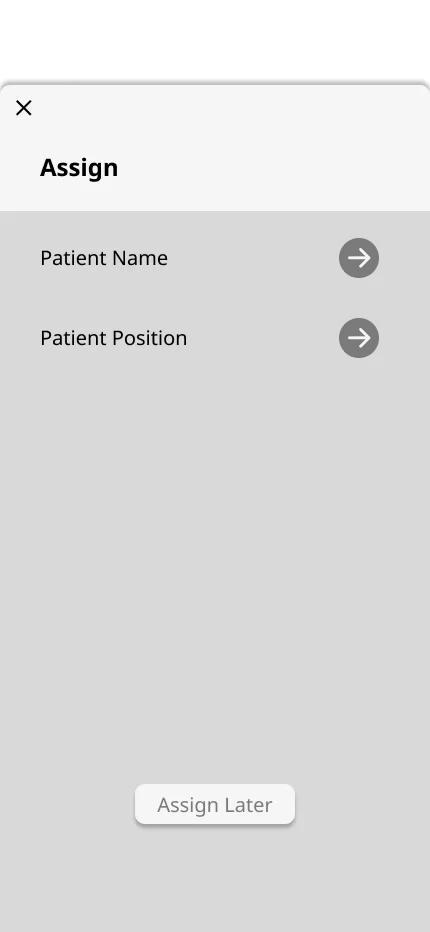
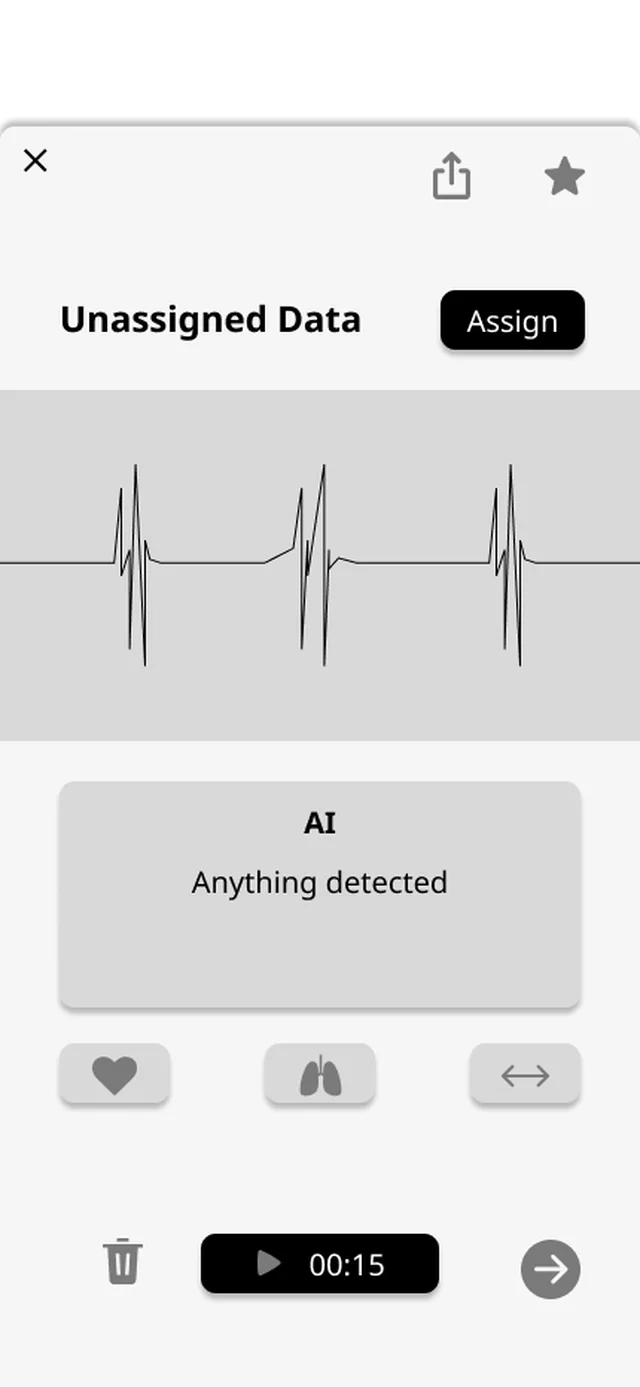
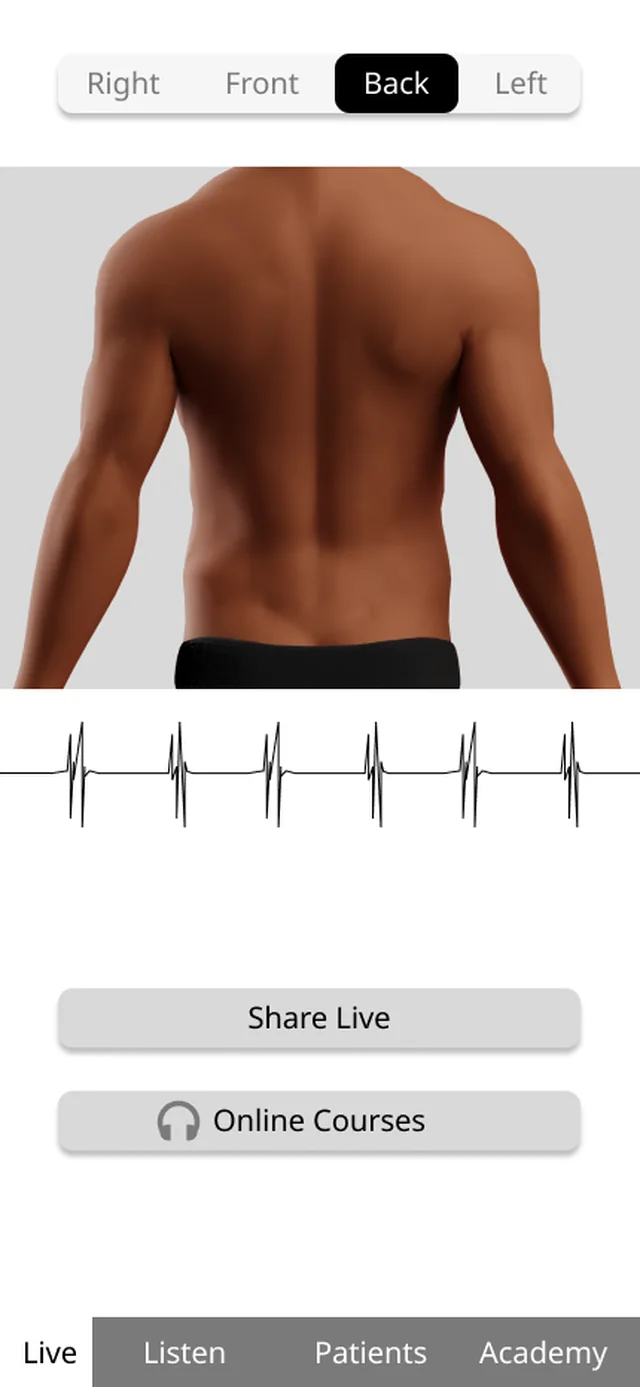
Tap a pin or a finding for the detail. Amber and red are problems, green ticks are what worked. The numbers carry through to UI 2.0.
Iteration
What did the field make me change?
What I worked on, and what I did not
Doctors do not trust the AIDoctors
Focus
If doctors will not trust what they hear and see, nothing else matters. The main thing to fix.
Labelling before you can recordCHOs
Focus
It slowed the very first step. Record first, label whenever.
No network, no consultCHOs
Focus
Where the network fails the consult stops, which blocks the whole idea.
No way to send audio on WhatsAppCHOs, doctors
Small change
It is how they already share, and cheap to add.
Batteries, Bluetooth, sound cues in noiseCHOs
In the device
Solved in the hardware: AA batteries, wired audio and a ring of light.
Fitting DocOn and eSanjeevani, doctor-to-doctor sharingDoctors
Parked
Clear only after testing. The live consultation led the first release.
Cost and theft worriesStudents
Parked
Not tackled in this round.
01
Doctors trusting the AI
Found. Until testing I had only made sure CHOs could get information across. I had not considered how to make the doctor comfortable with it, which is where trust is won or lost. Doctors rejected a black box: “If you just tell me this is the problem, solve it, I won’t trust it.” They wanted the data to check for themselves.
Now. The AI names each finding on the waveform, with its severity and a short reasoned summary, so the doctor can check it against the sound.
Why doctors distrust an instant answer
Effort
People equate time spent with quality, so a diagnosis in under a second feels cheap next to a human listening for minutes.
Algorithm aversion
Once people see an algorithm err, they lose trust in it faster than they would in a person (Dietvorst, Simmons and Massey, 2015).
Authority
Doctors spent years building diagnostic skill. A machine that skips their reasoning threatens it.
Do not design an AI that diagnoses. Design one that presents evidence. The AI is a witness, not a judge.
Six options, three used
Diagnosis
Bronchitis
Confidence 87%
AcceptRejectA: Instant verdict
Killed
A black box with a label and a confidence. The doctor cannot verify it.
Waveform
Crackle 0:12
Wheeze 0:28
▶ Play segment▶ Play segmentB: Annotated waveform
Kept · core
The AI shows where to look; the doctor decides what it is.
Analysing audio…
62%
✓ Crackles (0:12)
✓ Wheeze (0:28)
Scanning for murmurs…
C: Artificial delay
Killed
A fake wait wastes time in a short consult, and trust collapses once doctors notice.
AI observations
Crackles 0:12
?Freq 200–400 Hz
Duration 0.3 s
3 similar cases
Wheeze 0:28
?D: Interrogation panel
Kept · layer
Tap a finding to see its frequency, duration and baseline. Depth on demand.
Raw
AI
Show AI layer
E: Side by side
Killed
Two views double the load on a small screen. Doctors want one trusted view.
Observations
For your review
Crackles 0:12
ConfirmDismissWheeze 0:28
ConfirmDismissNo murmur
ConfirmDismissSign-off required
F: Second opinion
Kept · wording
“Observations”, not “diagnosis”, and the doctor confirms or dismisses each one.
B, D and F became the evidence timeline.
The merged design
Live consult
02:41
Waveform
LivePauseCrackle 0:12
Wheeze 0:28
▶ Play all▶ Play segmentShow AI reasoningAI observations, for your review
✓ Confirm✕ Dismiss? WhyCrackles at 0:12
200–400 Hz · 0.3 s
✓ Confirm✕ Dismiss? WhyWheeze at 0:28
400–800 Hz · 1.2 s
✓ Confirm✕ DismissNo murmur detected
Findings enter the record only after the doctor signs off.
The evidence timeline, on the doctor's screen during a live consult
The real screens, version by version
UI 1.0A box that says “anything detected”, and nothing to check it against. 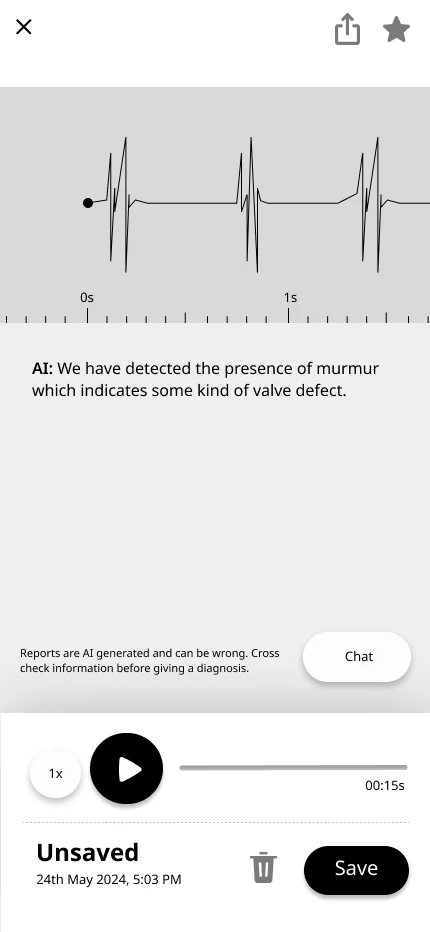
UI 2.0A sentence naming the finding, still apart from the sound. 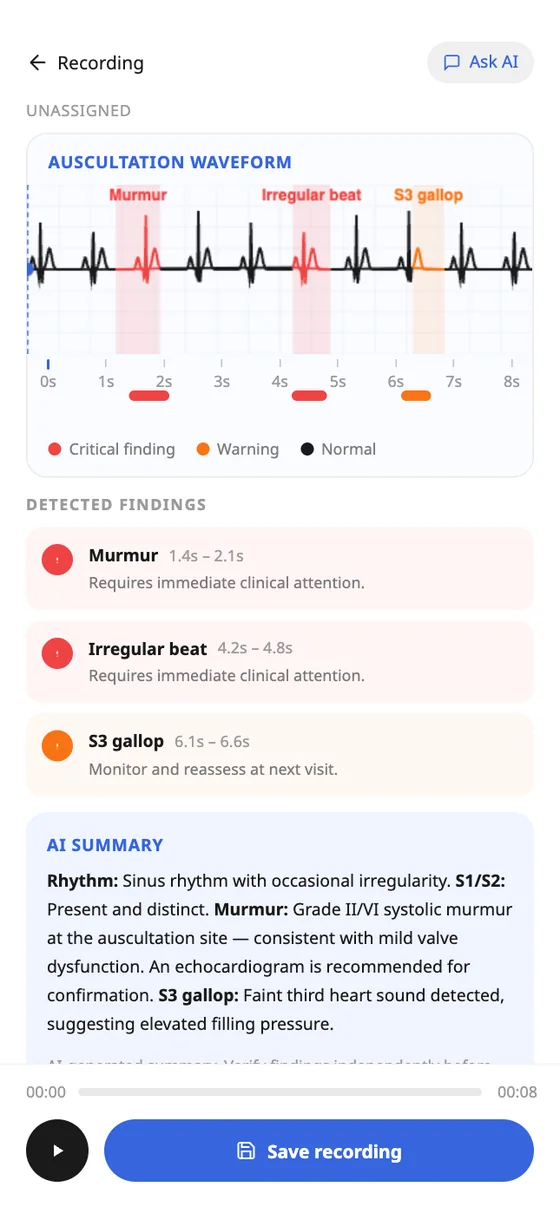
FinalEach finding is named on the waveform, with severity and a reasoned summary.
Result
“This feels really sophisticated now, and I can see if I want to trust it or not.”
Everything else that changed
- Hardware scoping. We initially designed two SKUs (Pro for hub hospitals, Lite for the field). For the MVP, we killed the Pro version to focus all engineering and manufacturing runway on the Lite device. Field reliability (AA batteries, rugged housing) was the critical bottleneck. The Pro version was moved to the Phase 2 roadmap.
- Live BPM in field noise. To handle field noise (stethoscope friction, heavy breathing), the app applies a low-frequency bandpass filter (20-150Hz) to isolate heart sounds and uses a 3-second moving average to smooth out artifacts. If motion noise exceeds a safe threshold, the BPM UI intentionally displays a "Listening..." state rather than showing a false number.
- Where to listen. The doctor taps the body and the CHO sees the spot, in words, on her own screen.
- Laying out the AI. One page in reading order: waveform, each finding, the reasoning, then Ask AI.
- Body map. Position moved from a text field to a tap on the body.
- Feedback without a screen. A ring of coloured light and voice in the earpieces, with AA batteries and wired audio.
- A home for the doctor. A desktop client that syncs automatically is the doctor's record, set aside for the first release. WhatsApp stays for quick sending.
- ABDM and eSanjeevani. Login through ABDM, and Ausculo opens as a plugin inside the clinic's case.
Final design
What did the design become?
This is the real app, running. Try it, or start from a flow.
Choose a language, create an account or sign in, choose the device, pair it, connect ABDM (or skip), choose what you plan to use it for.
Impact
What did the work produce, without a launch?
Ausculo has not entered the market. In healthcare that is not unusual — products spend years in development, testing and regulatory clearance. The design work still had tangible outcomes:
A validated direction
Three expensive missteps avoided
Primary research
A complete handoff
Published. Poddar, L., Koruprolu, V. S., Shaikh, M. N., & Aggarwal, M. (2025). Digital Stethoscopes for Telemedicine in Rural India: Designing for Usability and Practical Adoption. Proceedings of the Human Factors and Ergonomics Society Annual Meeting.
Read the paperReflection
What was the brief really asking for?
What started as "design a stethoscope for ASHA workers" became "design a trust-building communication system between CHOs and doctors, inside an existing national telemedicine infrastructure." The hardest problem was not usability. It was trust. And designing for a low-resource environment is not about simplifying — it is about being precise.
The most important decisions were not made in front of a screen. They were made in a PHC in McLeodganj when a CHO told me Bluetooth does not work in her village; in Sarah, when a health officer said the power does not come for 24 hours; and when a doctor in Dharamshala said, "I don't trust a recording I didn't direct."
Every decision — embedding position metadata in every recording, making the AI's reasoning visible, letting doctors control the stethoscope remotely, swapping charging docks for AA batteries — was about building one chain of trust between a CHO in a village and a specialist in a city, across 200 kilometres of bad network.