
From group chat to group trip
along · Group trips for Atlys

Summary
along is group trips for Atlys. It takes a group from the chat to a trip they agree on and book together. A 3-day design challenge, delivered as a coded prototype.
Team
- Me, solo
Platform
- Web
Timeline
3-day timebox
Started 14 Nov 2026
Context
Atlys does online visa processing. It handles 700,000+ visa applications a year across 120+ destinations. This was a 3-day design challenge from Atlys, “From Group Chat to Group Trip”.
The brief
Design an experience that takes a group from “we should go somewhere” to a concrete trip plan the group agrees on. It had to be AI-native: where AI adds value beyond a conventional travel app, what AI does, what the user controls, and how it handles uncertainty, conflicting preferences and poor results.
My goal
Help a group agree on where to go, when, and how much to spend, and then book it together on Atlys.
Research
This was desk research. I read published reports and surveys on Indian travellers: Niyo Travel Report 2025, Wise Passport & Paisa 2026, Airbnb / YouGov 2026, EY and The Economic Times, Skyscanner, and a published thesis survey of 94 people on group trips (Aalborg). Then I compared the tools that exist today. I did not interview or test with users.
What the reports say about Indians travelling abroad
Who travels
9 in 10
trips abroad are by Gen Z and millennials
Niyo Travel Report 2025
Why
Holidays
Long weekends, festivals and events. 62% of Gen Z plan trips around concerts and festivals.
Airbnb / YouGov 2026
From
2 in 3
trips start in Delhi, Bengaluru or Mumbai
Niyo Travel Report 2025
Where to
- Thailand23%
- UAE22%
- Georgia10%
Short trips in Asia
Niyo Travel Report 2025
Budget
Under ₹1L
per person per trip, for about half of travellers
Wise, Passport & Paisa 2026 (1,000+ travellers)
What matters
Easy visa. Good flights. Price.
51% of Gen Z put cheap flights and stays first.
EY and The Economic Times; Skyscanner
Who they travel with
- Solo63.8%
- Together36.2%
Couples 19.9% · Families 12.3% · Groups 4.0%
Couples, families and groups all plan the trip together.
Niyo Travel Report 2025
Biggest problems
- #1Keeping to a budget
- 88%Matching dates, in a group
Visas are filed one by one, so some groups show up as solo trips.
Budget: Wise 2026. Dates: Aalborg thesis survey of 94 people.
Who does this today
I compared the travel platforms, chat and group apps and AI assistants a group uses today, on each part of the trip.
| Ideas | Plans the trip | Group decides | Visas | Books | Splits costs | |
|---|---|---|---|---|---|---|
| Travel platforms | ||||||
| MakeMyTrip · Myra | ||||||
| ixigo · TARA | ||||||
| WanderOn, Thrillophilia | ||||||
| Chat and group apps | ||||||
| Troupe | ||||||
| Wanderlog | ||||||
| Splitwise | ||||||
| AI assistants | ||||||
| ChatGPT | ||||||
| Claude | ||||||
| Atlys group trips | ||||||
The opportunity
Most trips abroad are solo (63.8%), so most travel products are built for one person. But 36% of trips are taken together, by couples, families and groups, and they have to plan together. No tool covers that whole trip, from ideas to splitting costs. That is the space to enter.
Strategy
MVP: group trips only.
This is how the product finds, activates, converts and retains people.
Retention feeds acquisition
Acquisition
Discover
- Claude
- ChatGPT
Leads to
These platforms let people discover us.
Activation
Plan
Group booking
Multiple people coming together and working together, which is what gets people in
Agents for everyone
Even if they don’t have the time to plan, we still have something for them, so inviting more people never slows the trip
Leads to
Every invite counts: one organiser brings 3–8 people who now know us.
Conversion
Book
Experience
Polls in the plan
Anyone adds an option, everyone answers in one tap
Several plans side by side
Reacting is easier than inventing, so groups decide faster
Group visa check
One stuck visa sinks the trip; Atlys checks all of them
Price in money and leave
From each person’s home city
“Decide by” date
From visa time and fares, not set by a person
Pay your own share
Paying is the “I’m in”; nobody fronts money
Leads to
Simple, clean and efficient. The reason to stay with us.
Retention
Come back
Ideas on the home page
Places, events and long weekends in your budget
Quick starts
From WhatsApp, Claude or ChatGPT, in a sentence
Leads to
The quick answer to “let’s go somewhere”, so the next trip starts here.
↺ Retention feeds acquisition
How is AI going to supplement group bookings?
After the strategy, this was the first thing I tried to figure out. I explored multiple avenues for how the structure of the application could be, and I was looking at these options.
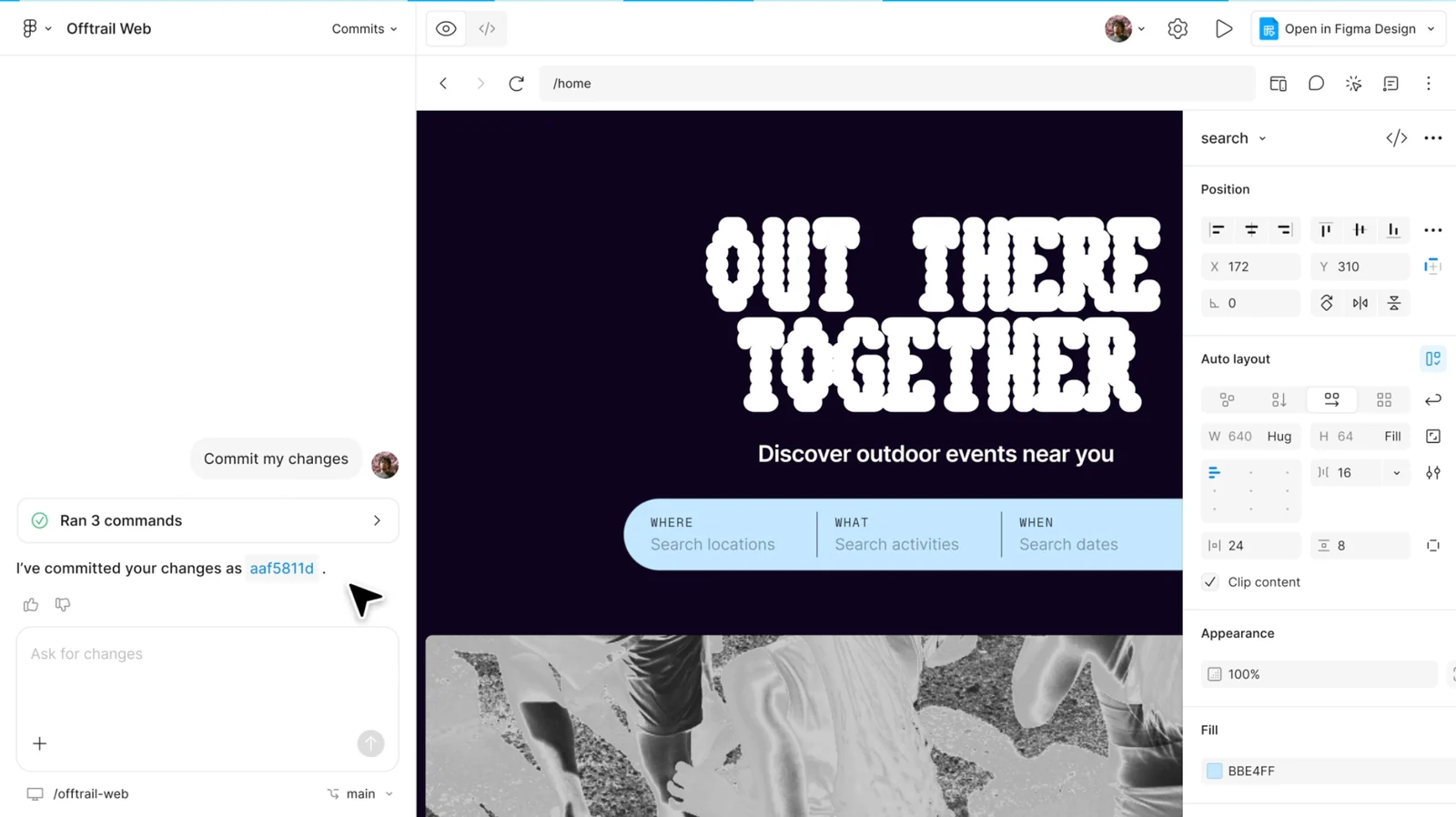
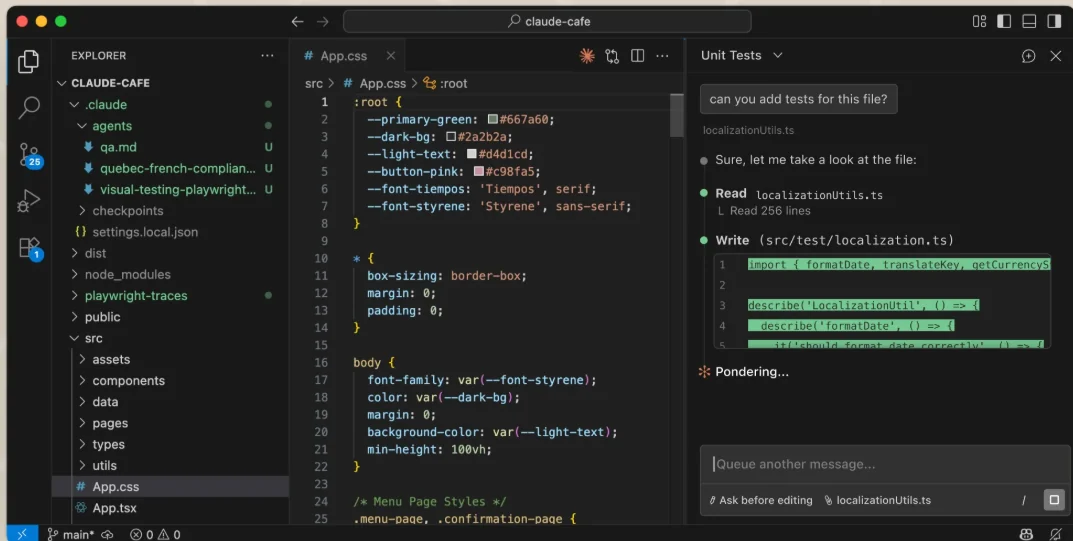
A chat, with the build on the side
Figma Make, Claude Code, or any of these IDEs: a chatting console, and the development happening on the side.
- Figma Make
- Claude Code
A shared canvas
Applications like Miro and FigJam: a massive canvas where you all come together with cursors and start forming a plan together.
- Miro
- FigJam
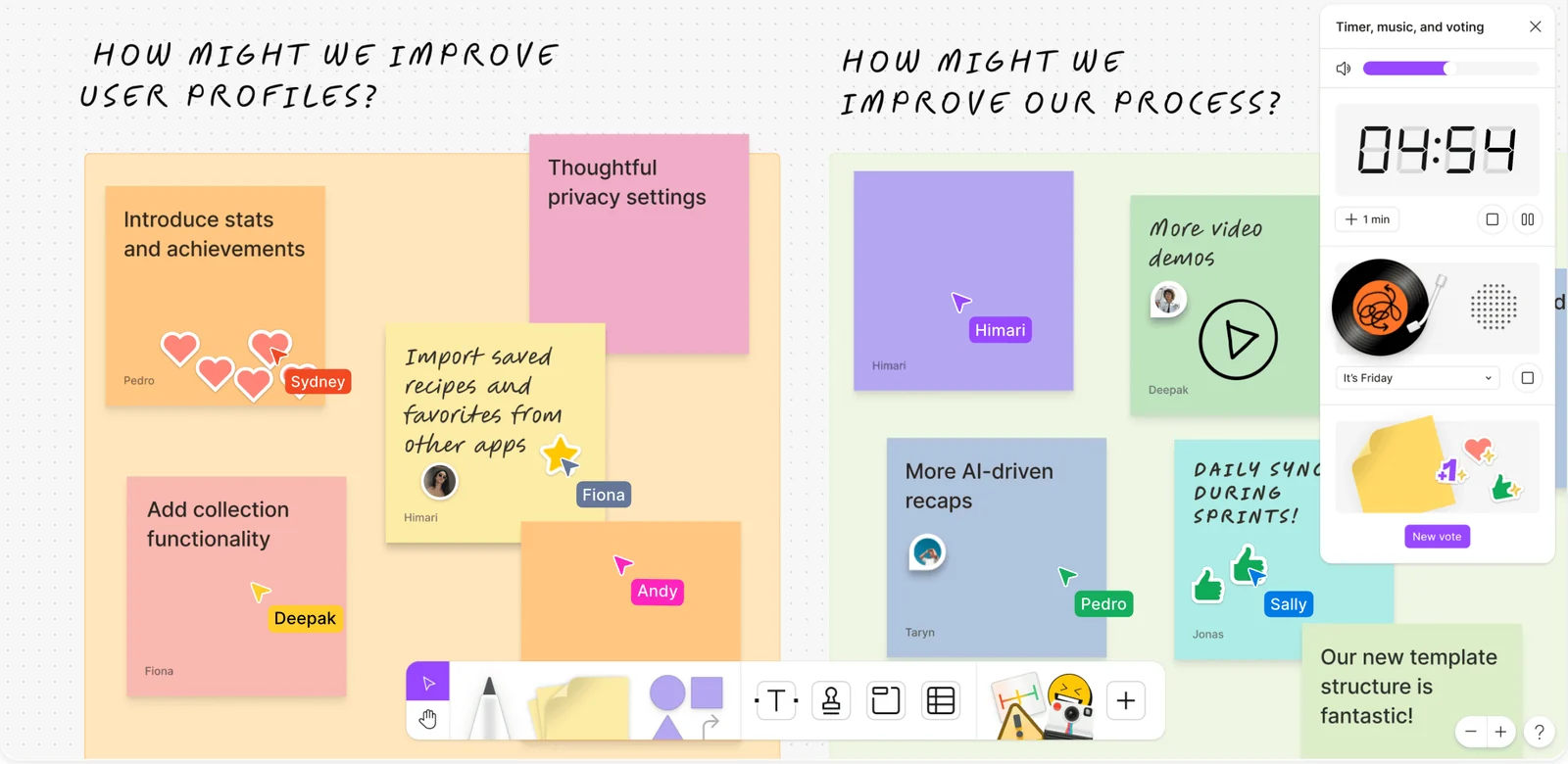
FigJam
An AI chat, with more people in it
A simple ChatGPT, Claude or Gemini kind of interface, where you are just talking straight. This time you bring in more people who are also talking.
- ChatGPT
- Claude
- Gemini
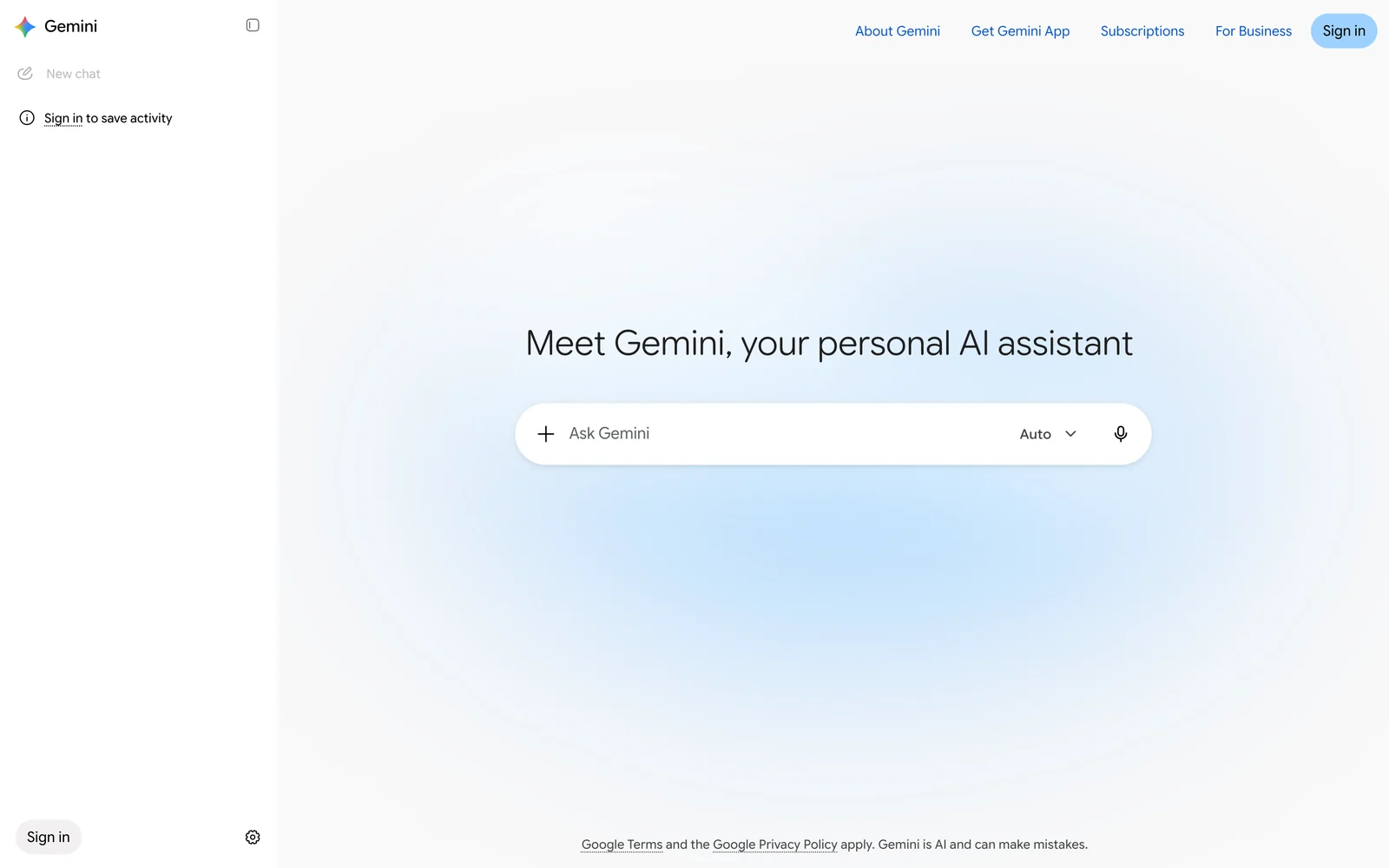
Gemini
Personal agents
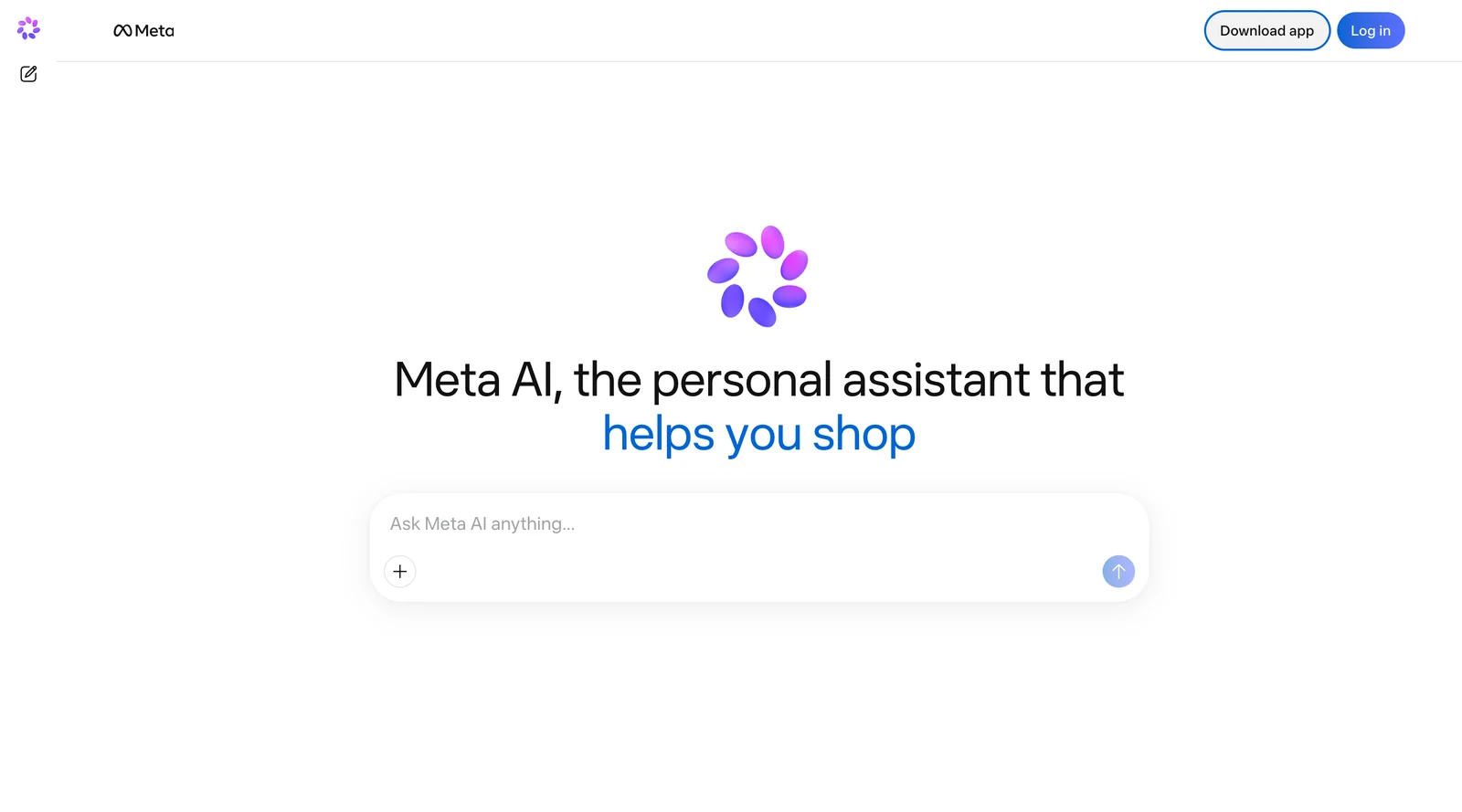
You have your personal agent and you deploy it: “Figure out this plan with this person.” Everybody does the same thing. Meta AI has the personal agent side of this.
- Meta AI
Meta AI
A normal travel app, with AI added
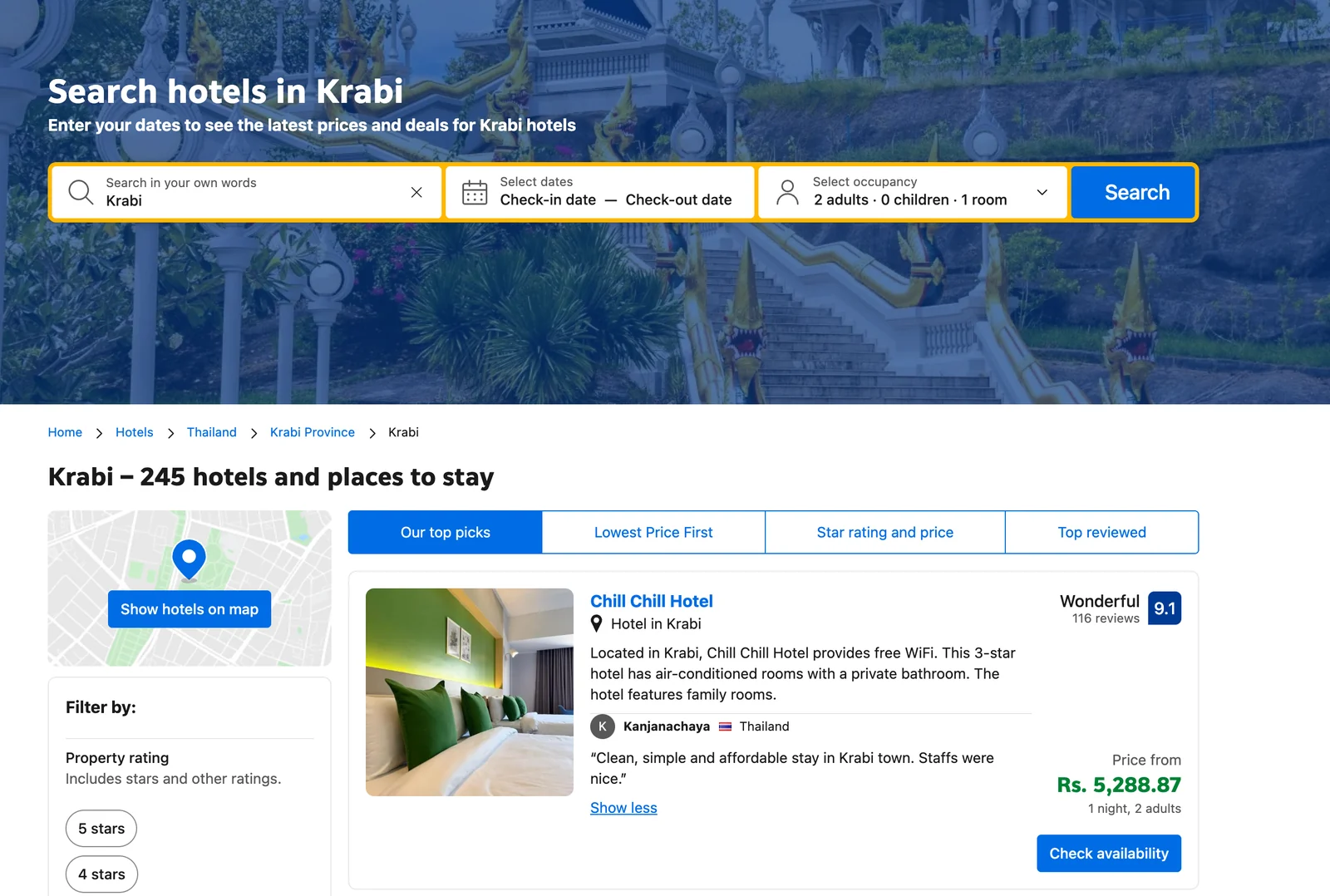
MakeMyTrip, Expedia or Booking.com, with AI added to it: working out the cards and interactions that make acquisition, activation and retention better.
- MakeMyTrip
- Expedia
- Booking.com
Booking.com
Seven prototypes
These were all different ideas, and I have prototypes for each of them: seven interaction models in one prototype.
One prototype, seven models
A dark bar on top switches between the models. One shared mock trip runs through all of them.
- Chat
- Chat + board
- Shared canvas
- Chat drives canvas
- Personal agents
- Private prep
- UI first, subtle AI
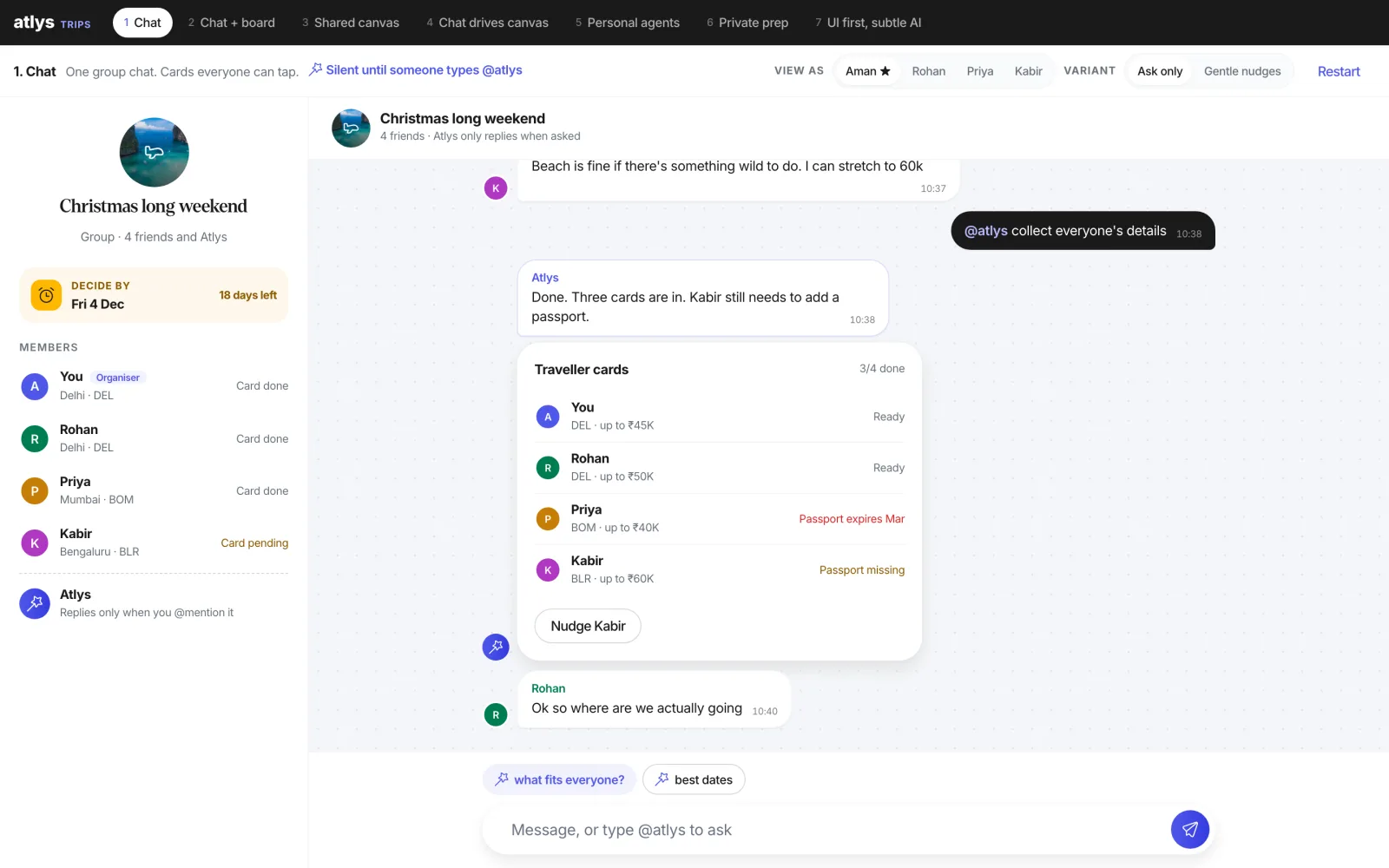
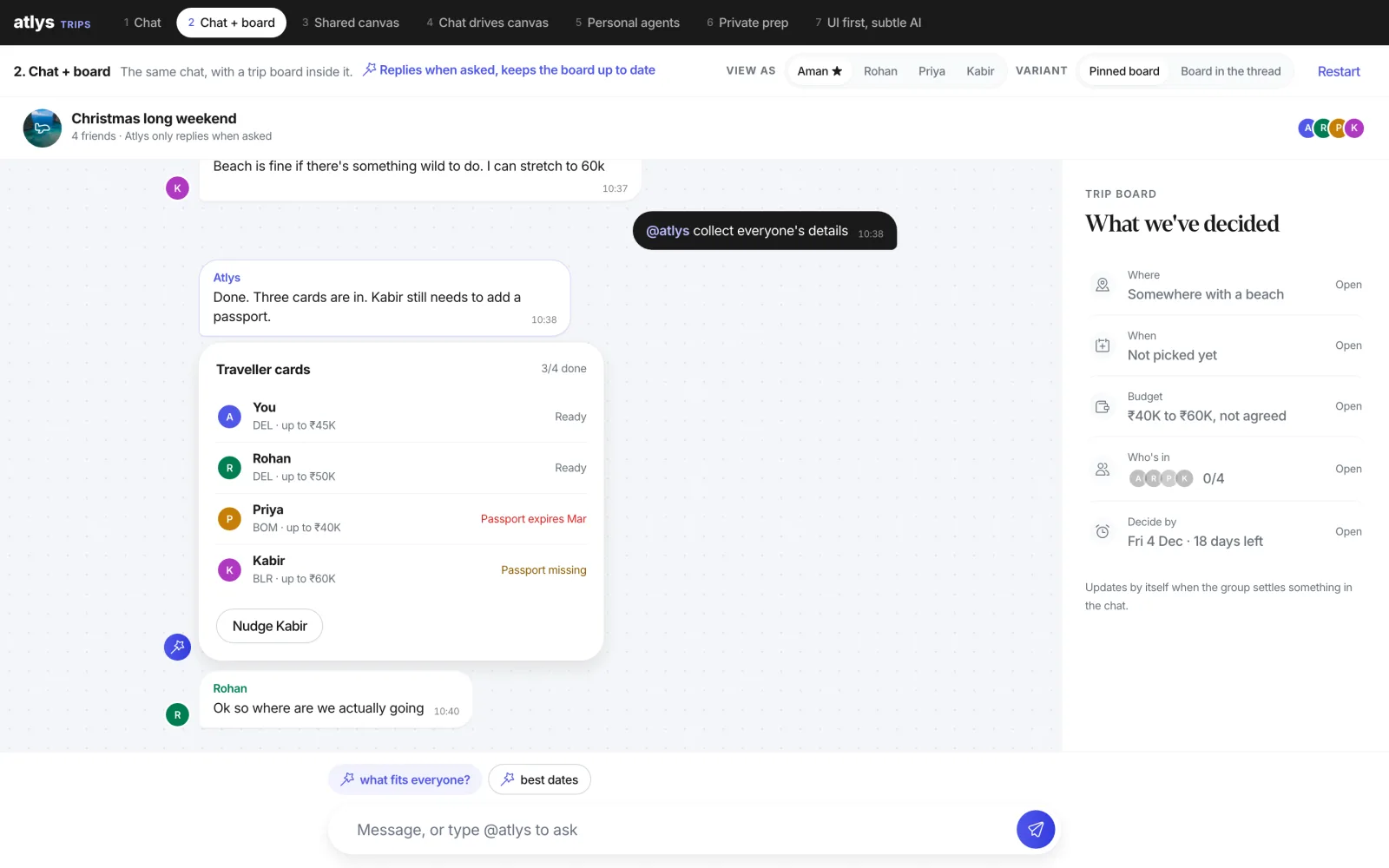
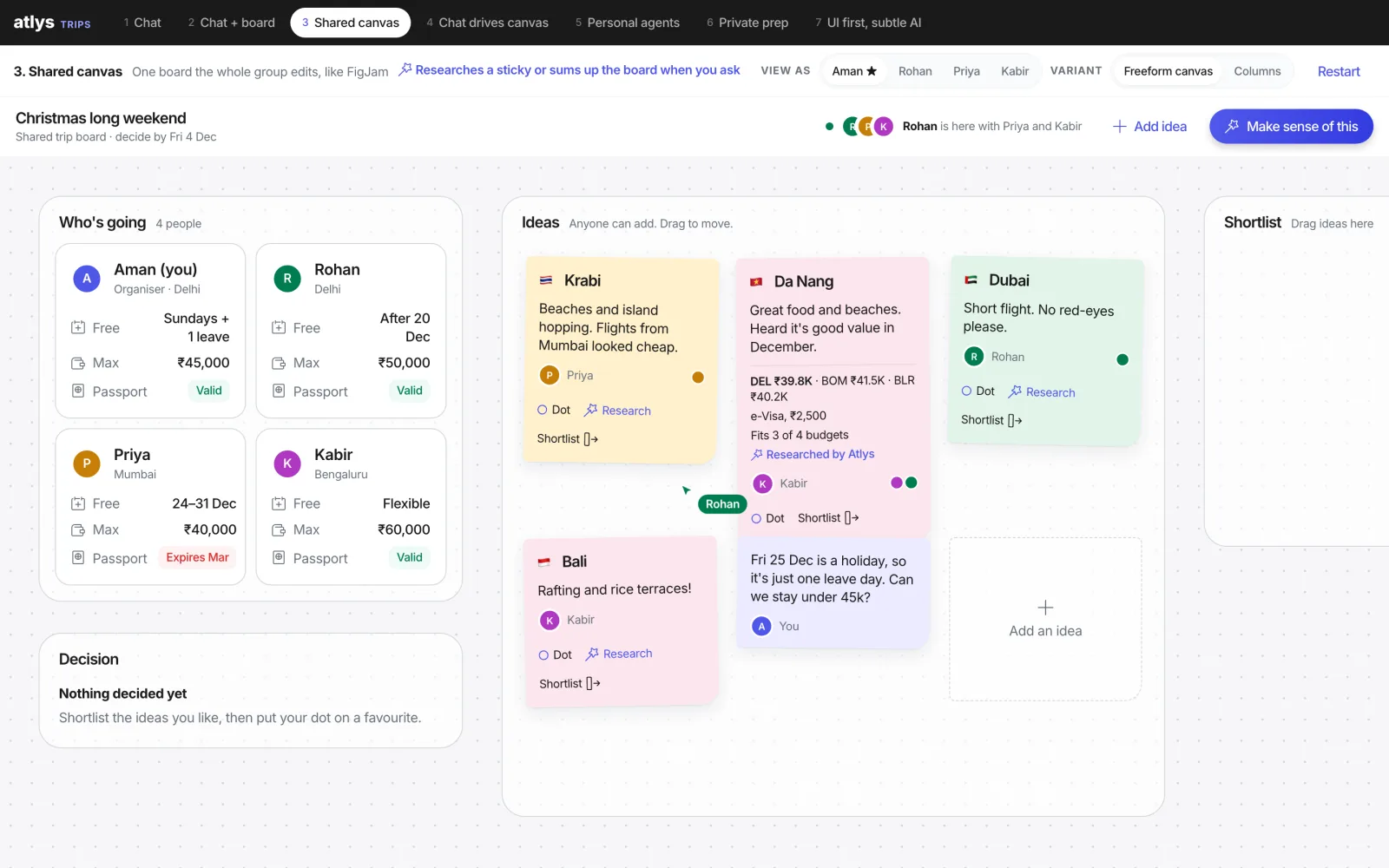
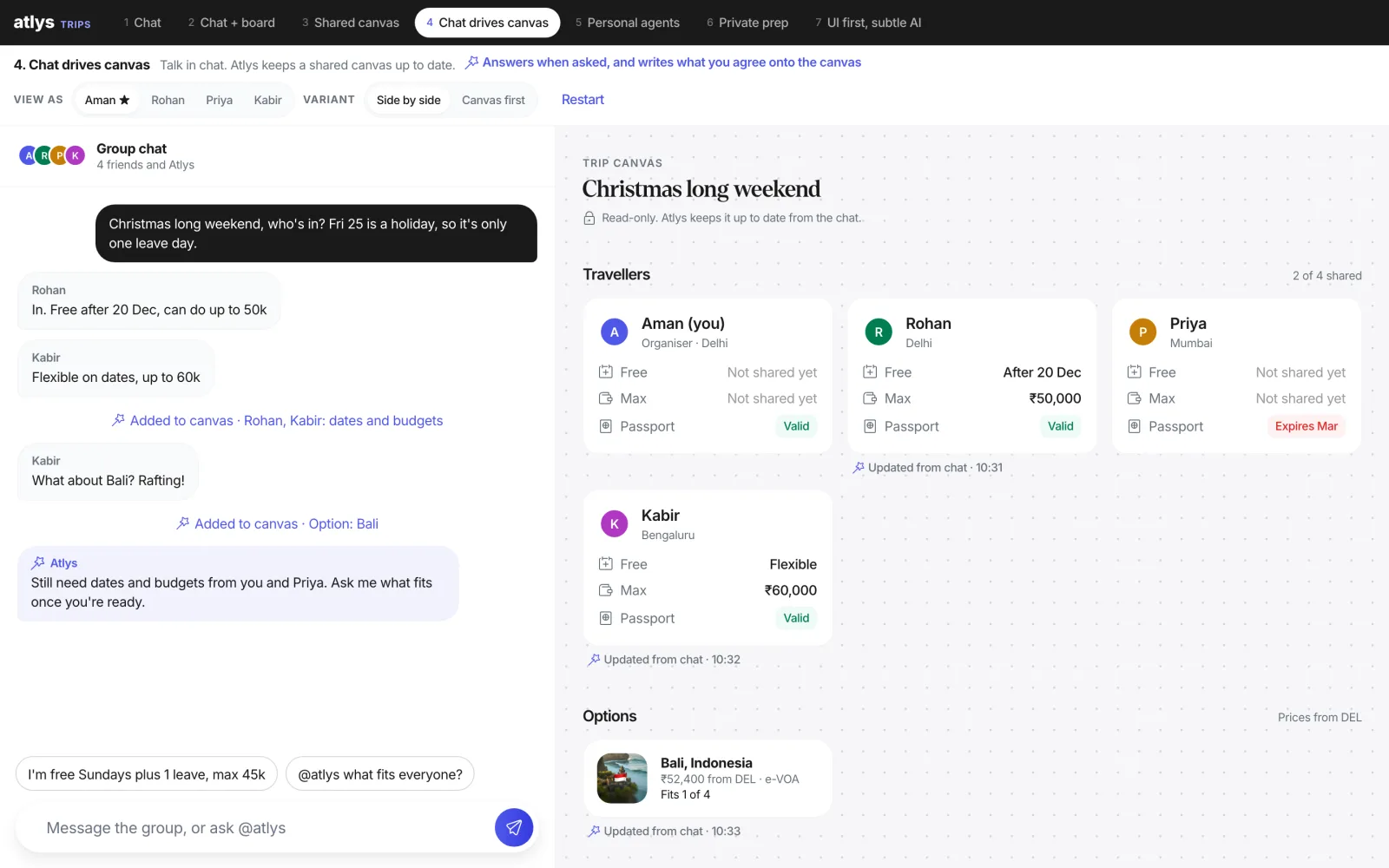
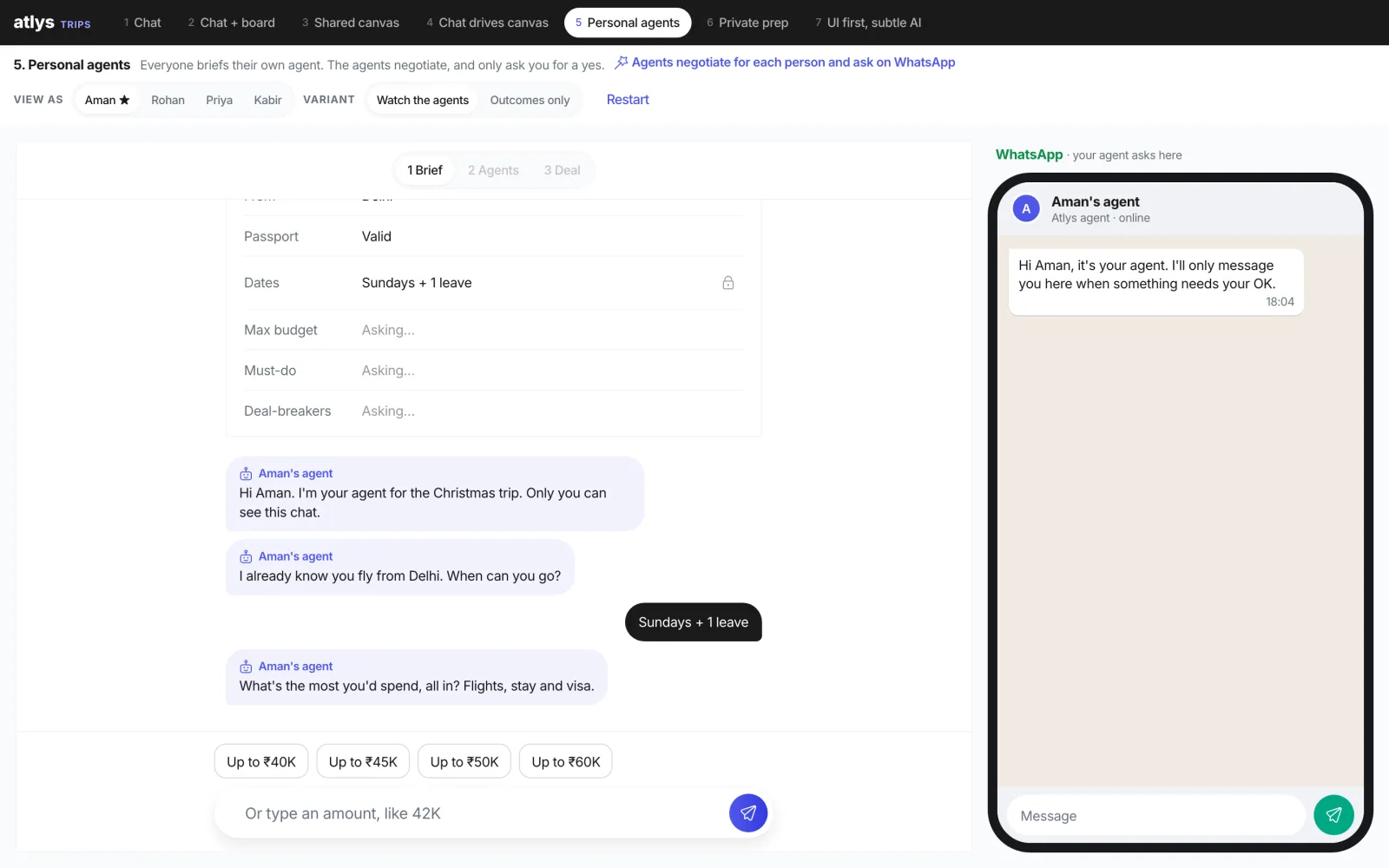
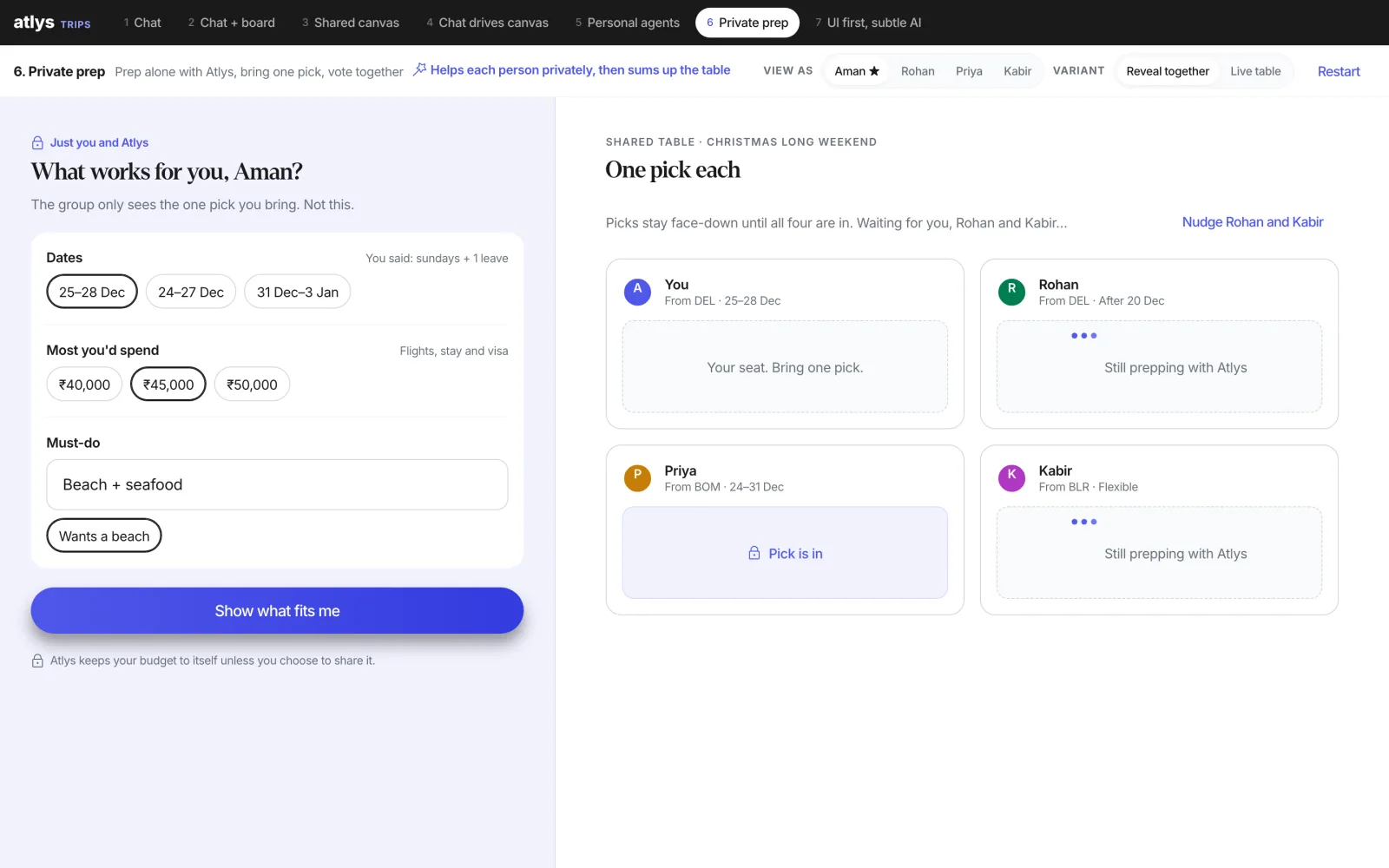
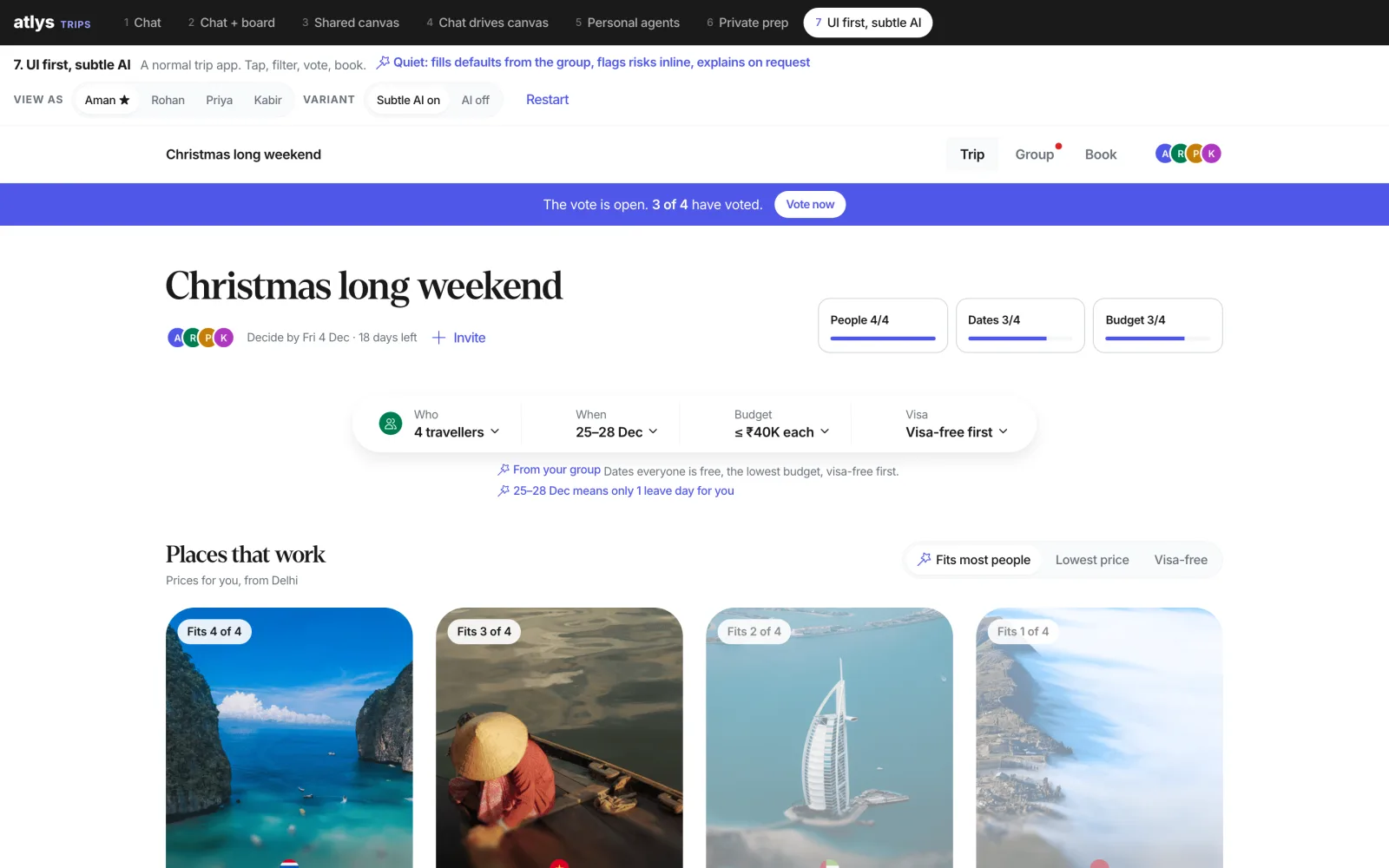
Each prototype was rated, and then they were combined for the pros and cons.
The final idea
You have your personal agent, and you also have a chat you interact with, with a canvas on the side.
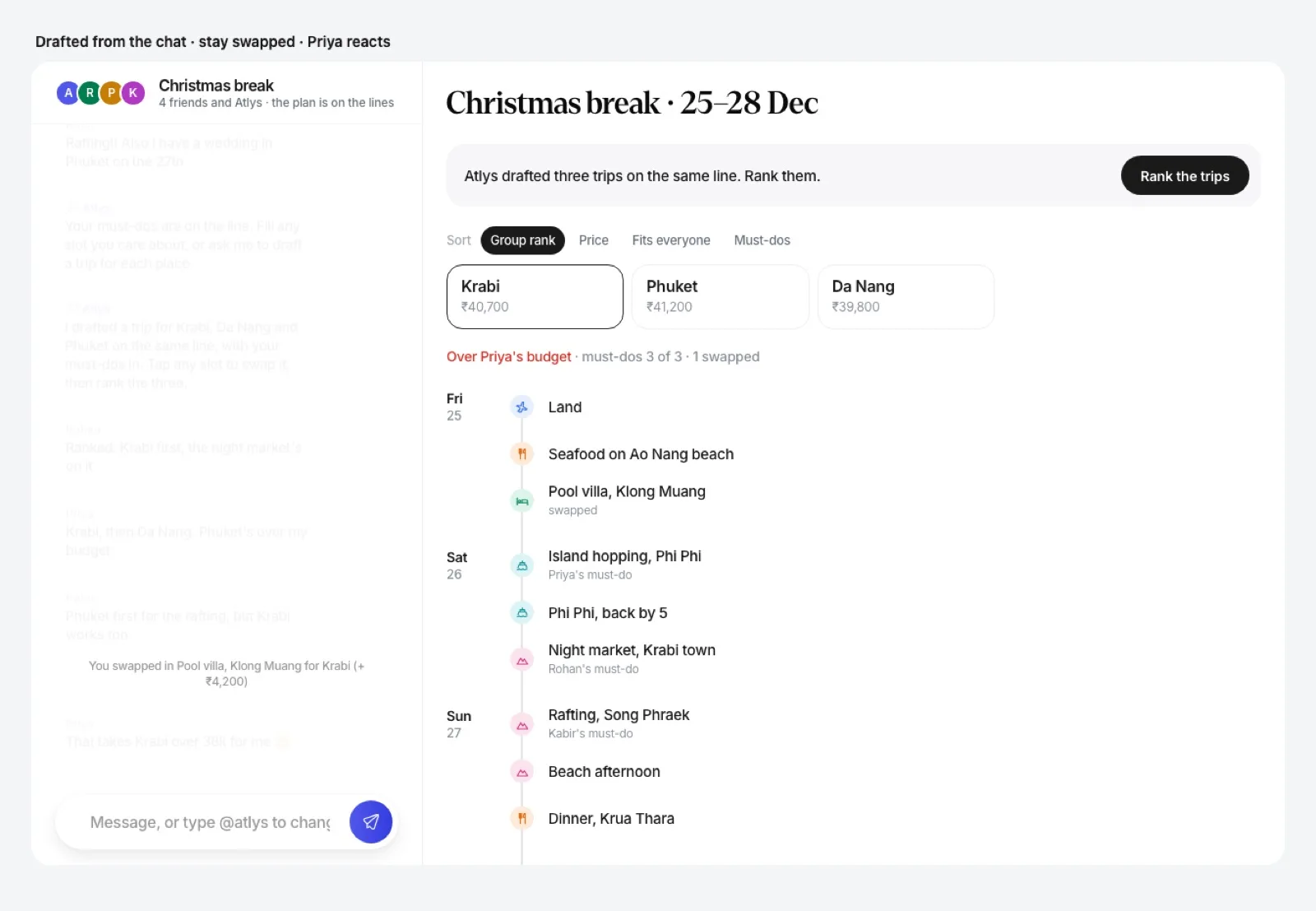
The chat, with the plan on the side
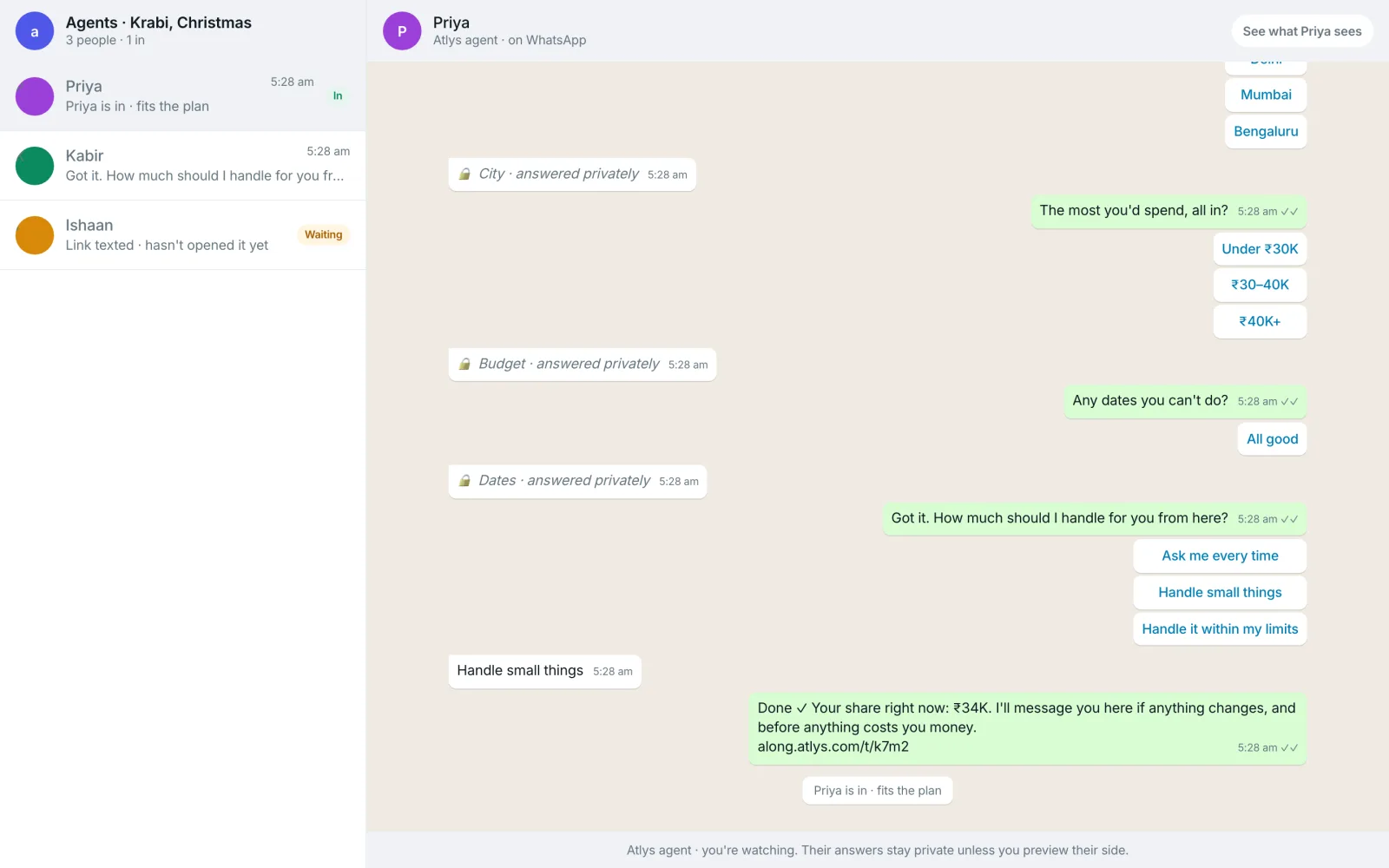
The personal agents
Brand system
Adding elements to this, I also had to define a brand system for it.

The wordmark
A Spotify-style layout
I initially went for a Spotify-style layout.
- Spotify
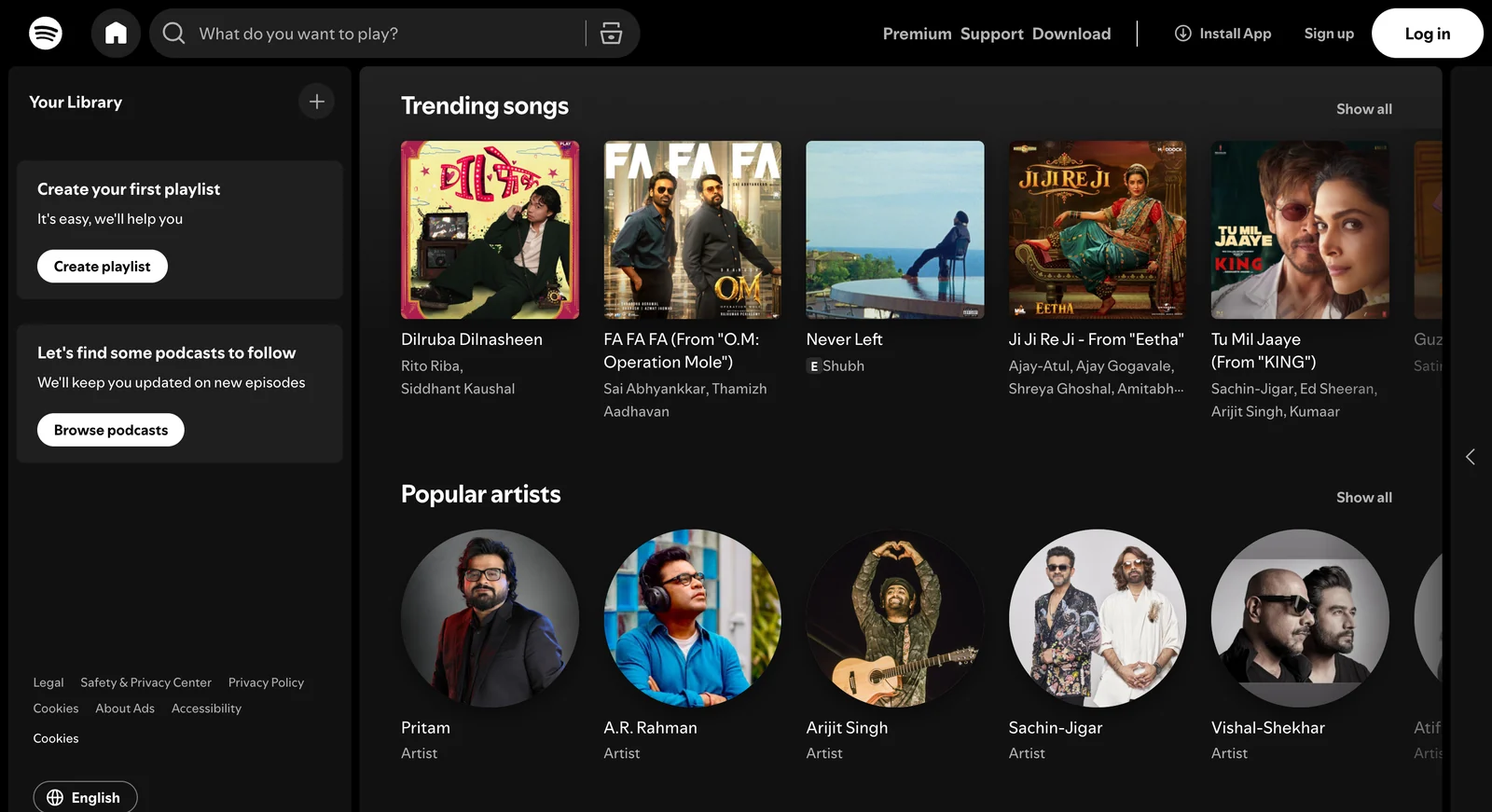
Spotify
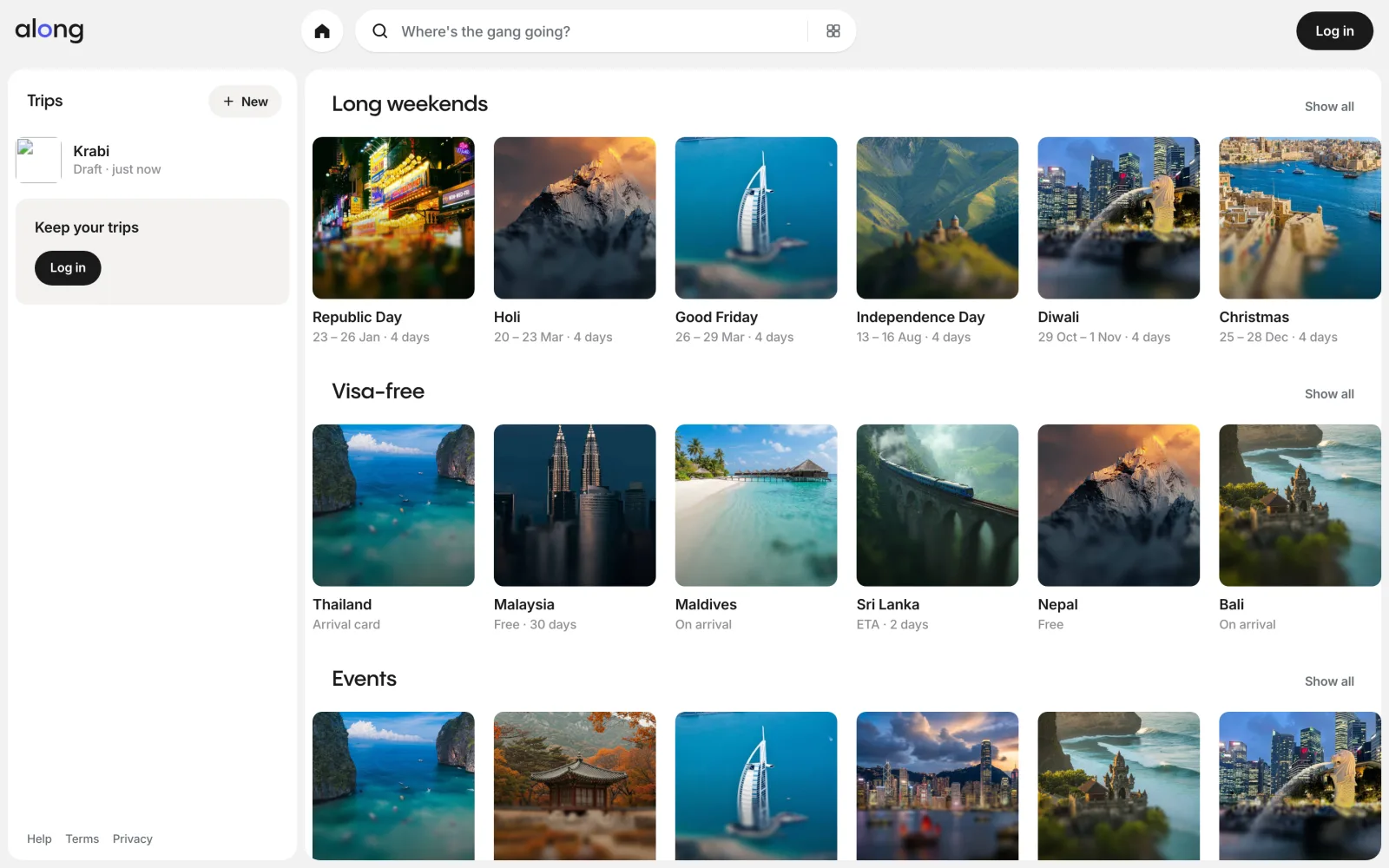
My Spotify-style layout
It started to feel boring
This started to feel a little bit boring, and there are so many interesting designs coming out with AI coming into the picture.
I wanted to do something bold and experimental. Since this is the first application, we want to create a mark. Marketing becomes another one of the aspects the application should embody.
The final prototype
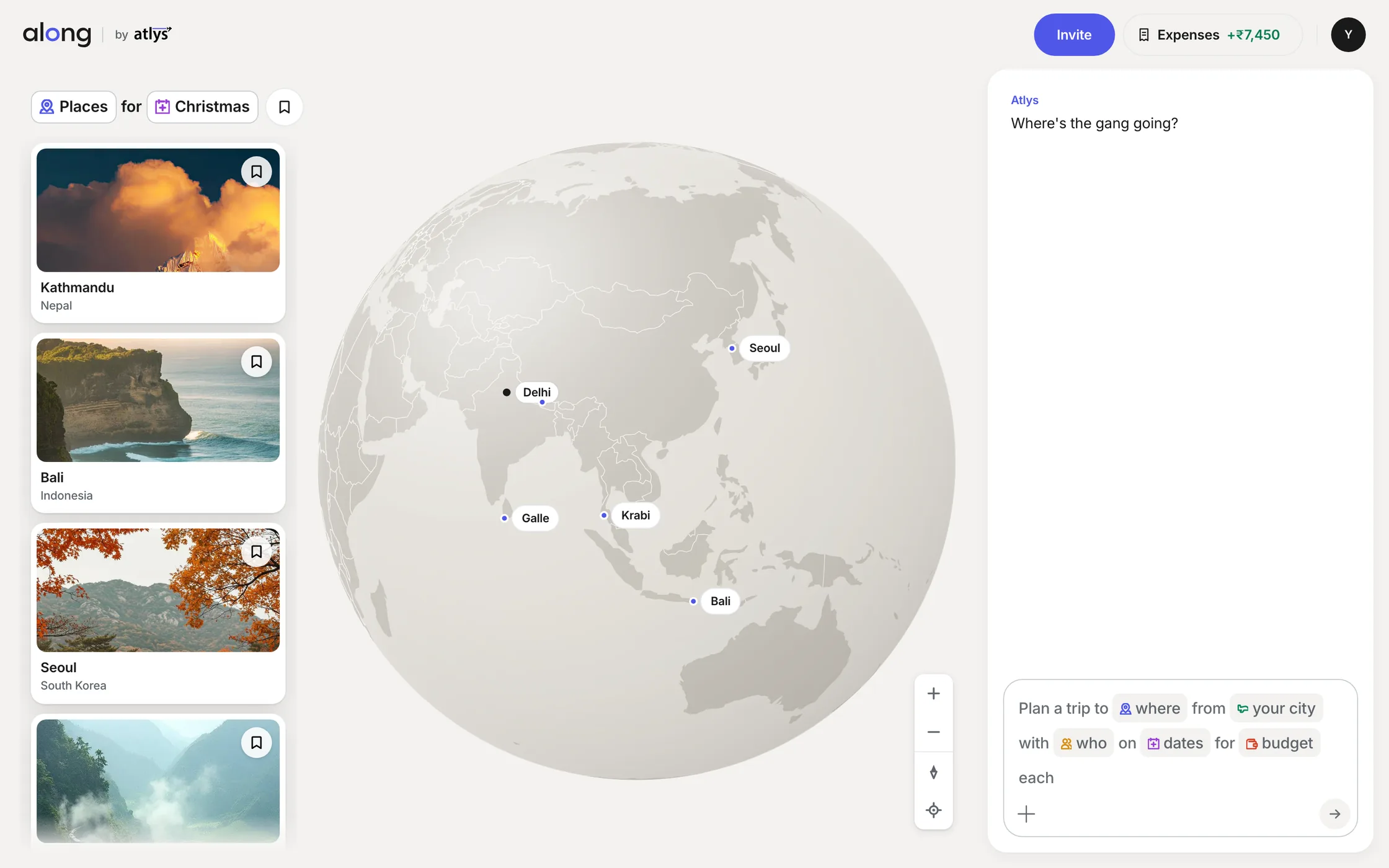
That led me to building the final prototype, which is a lot more graphic, with a globe in the centre.
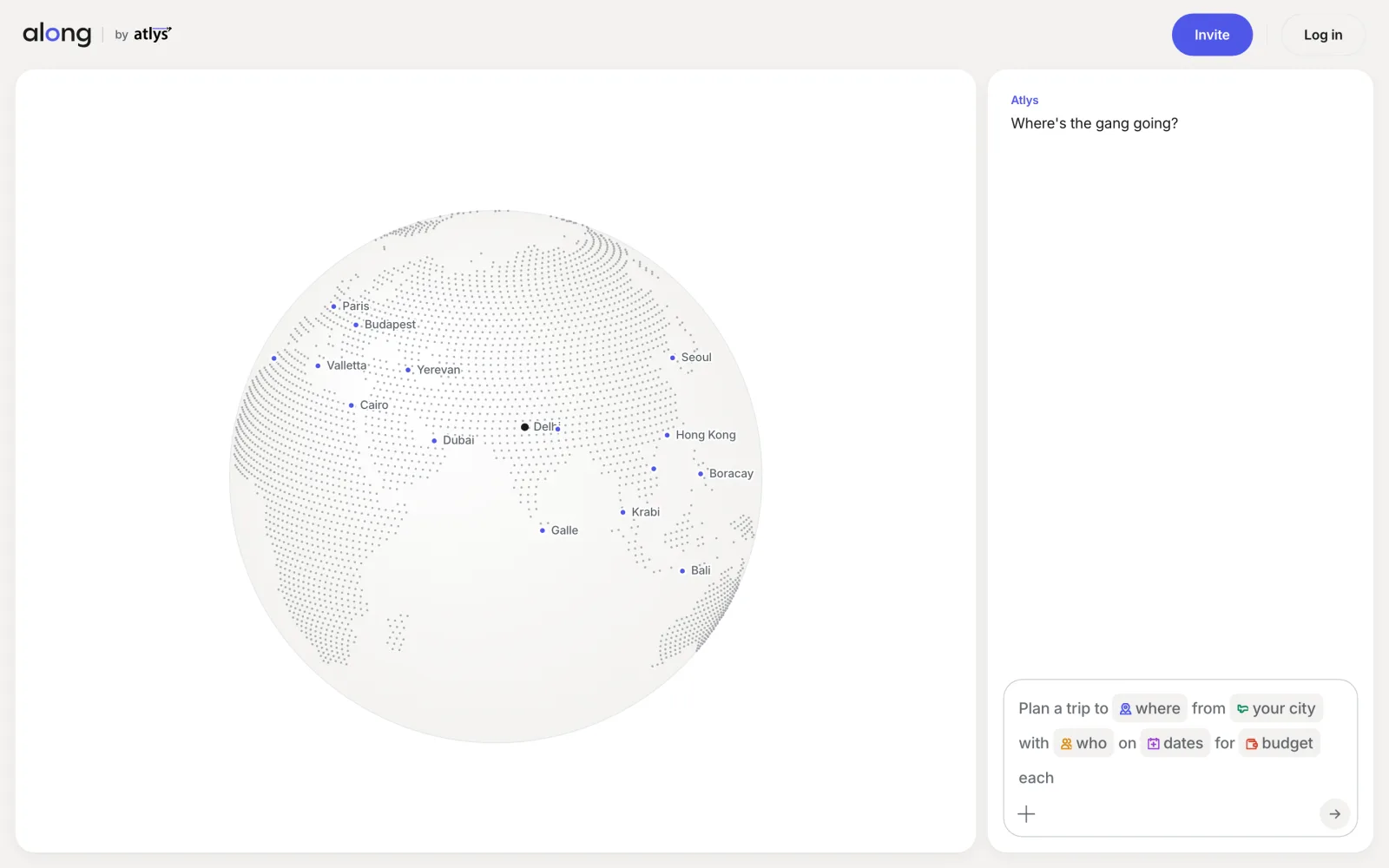
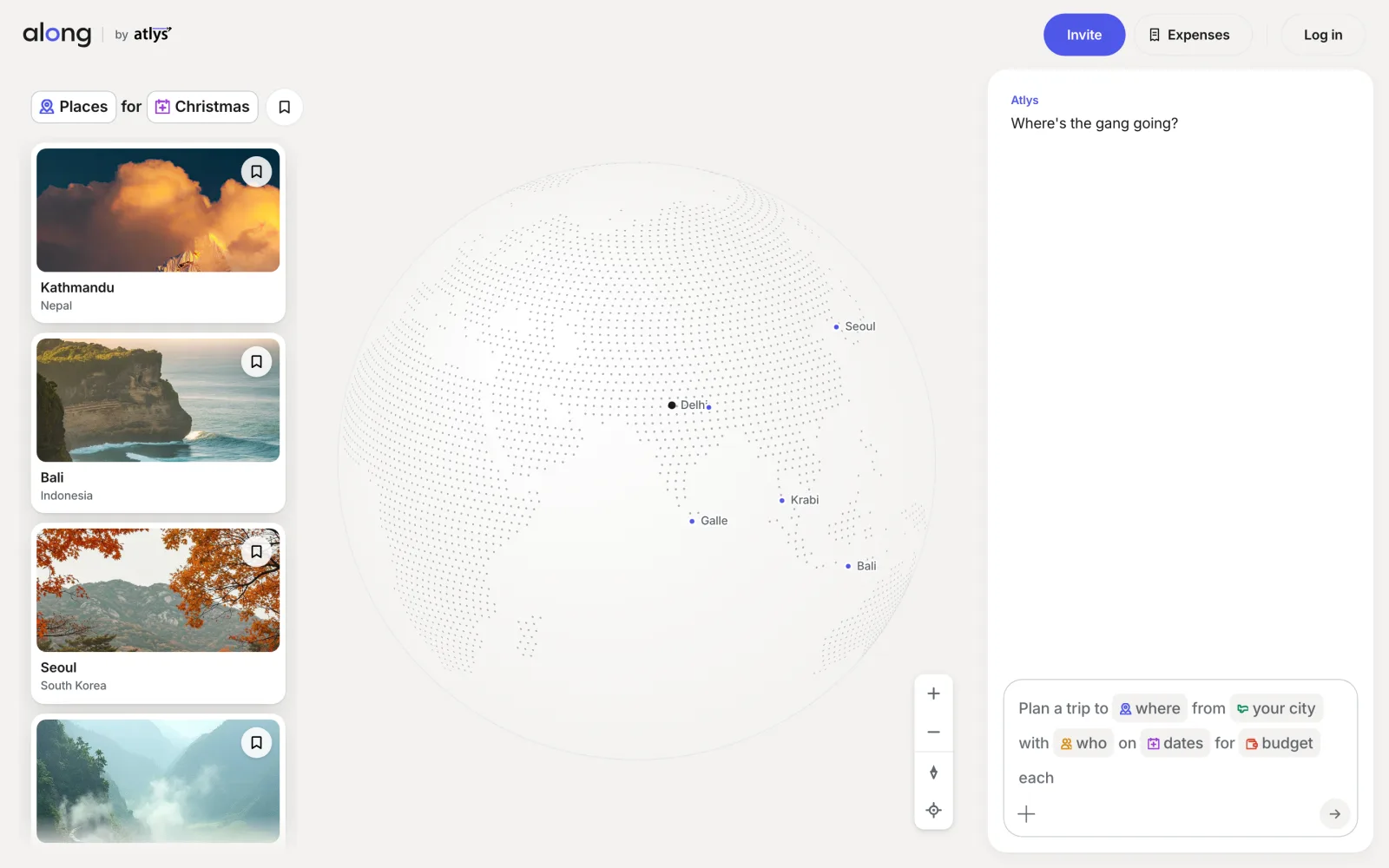
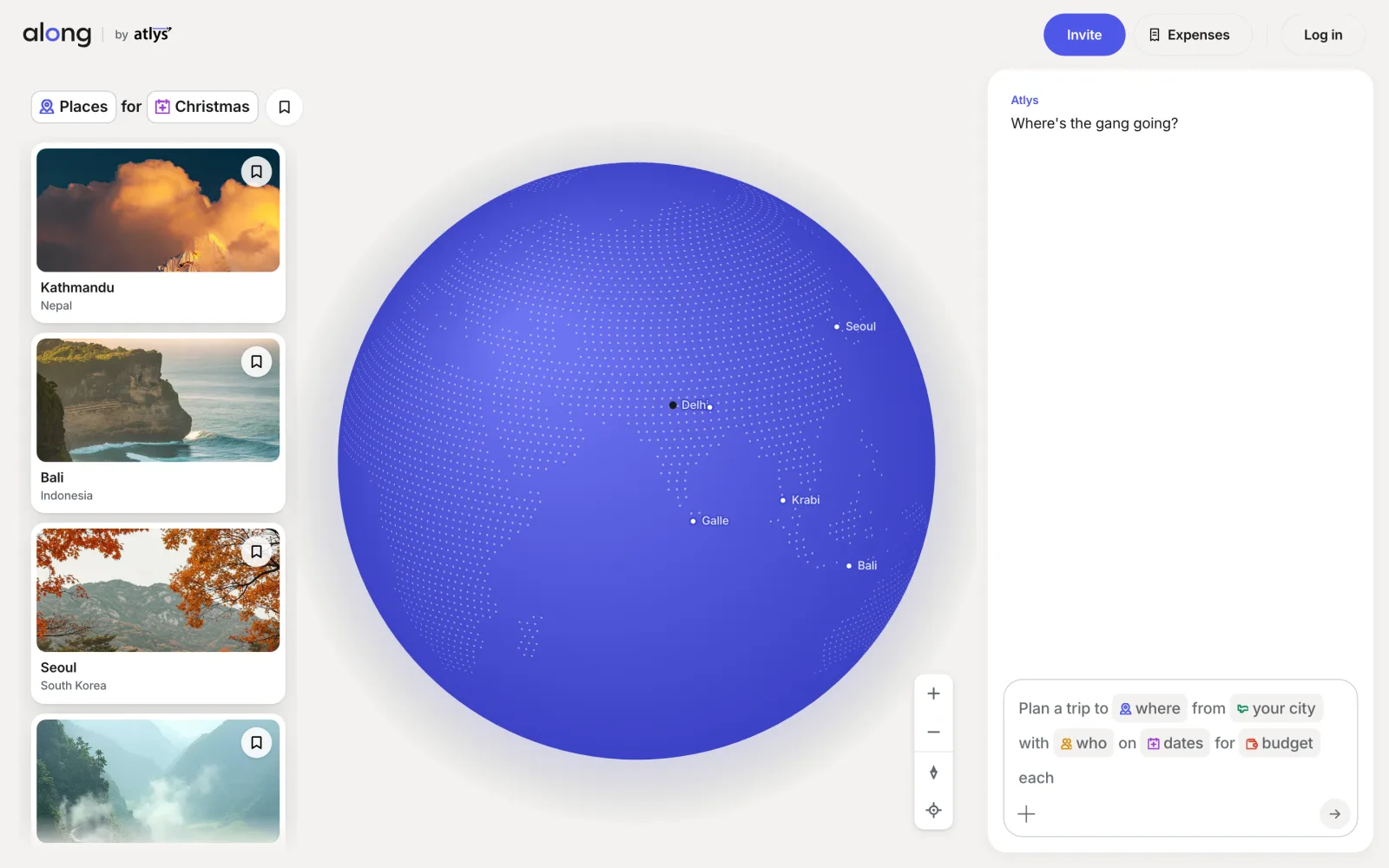
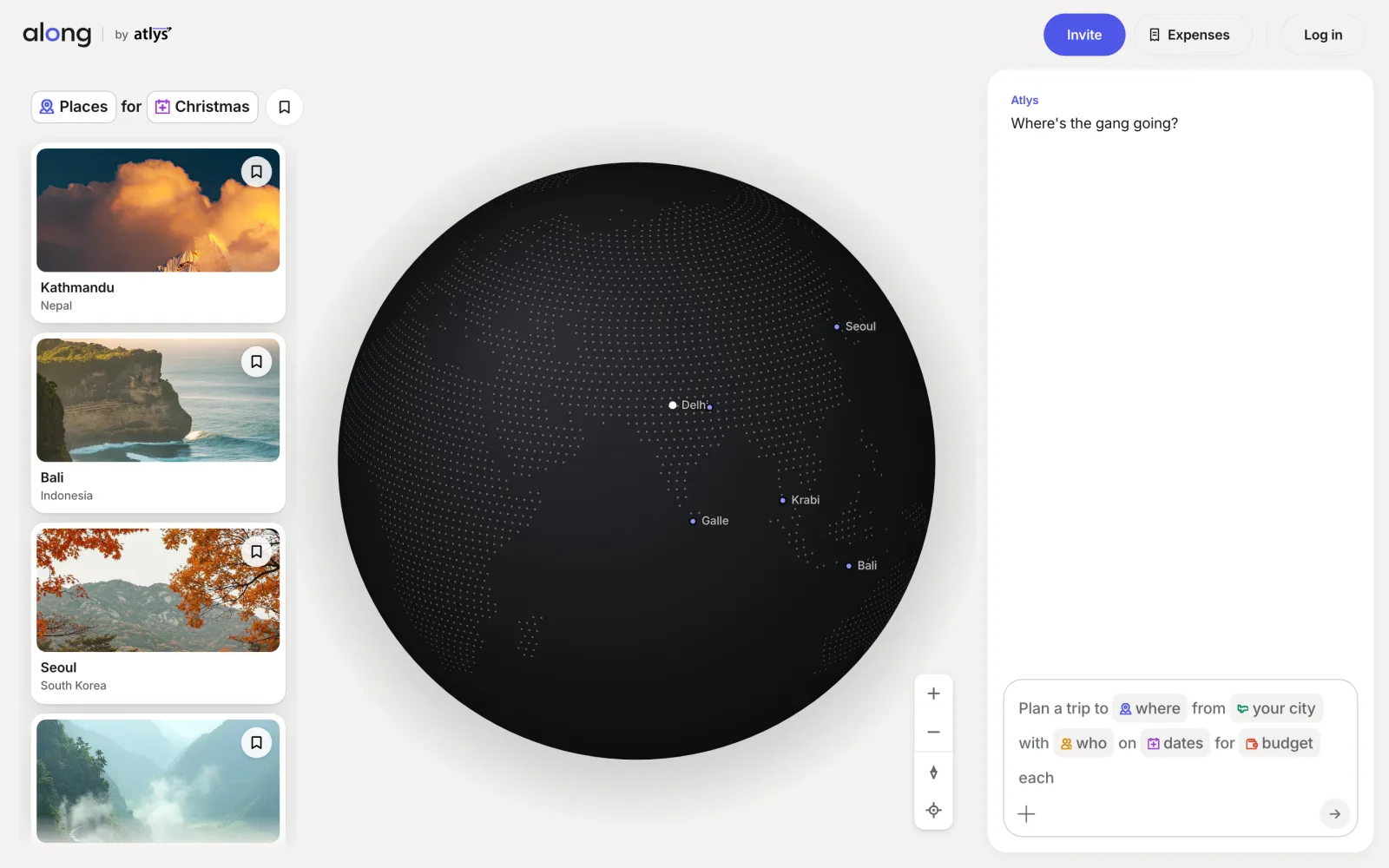
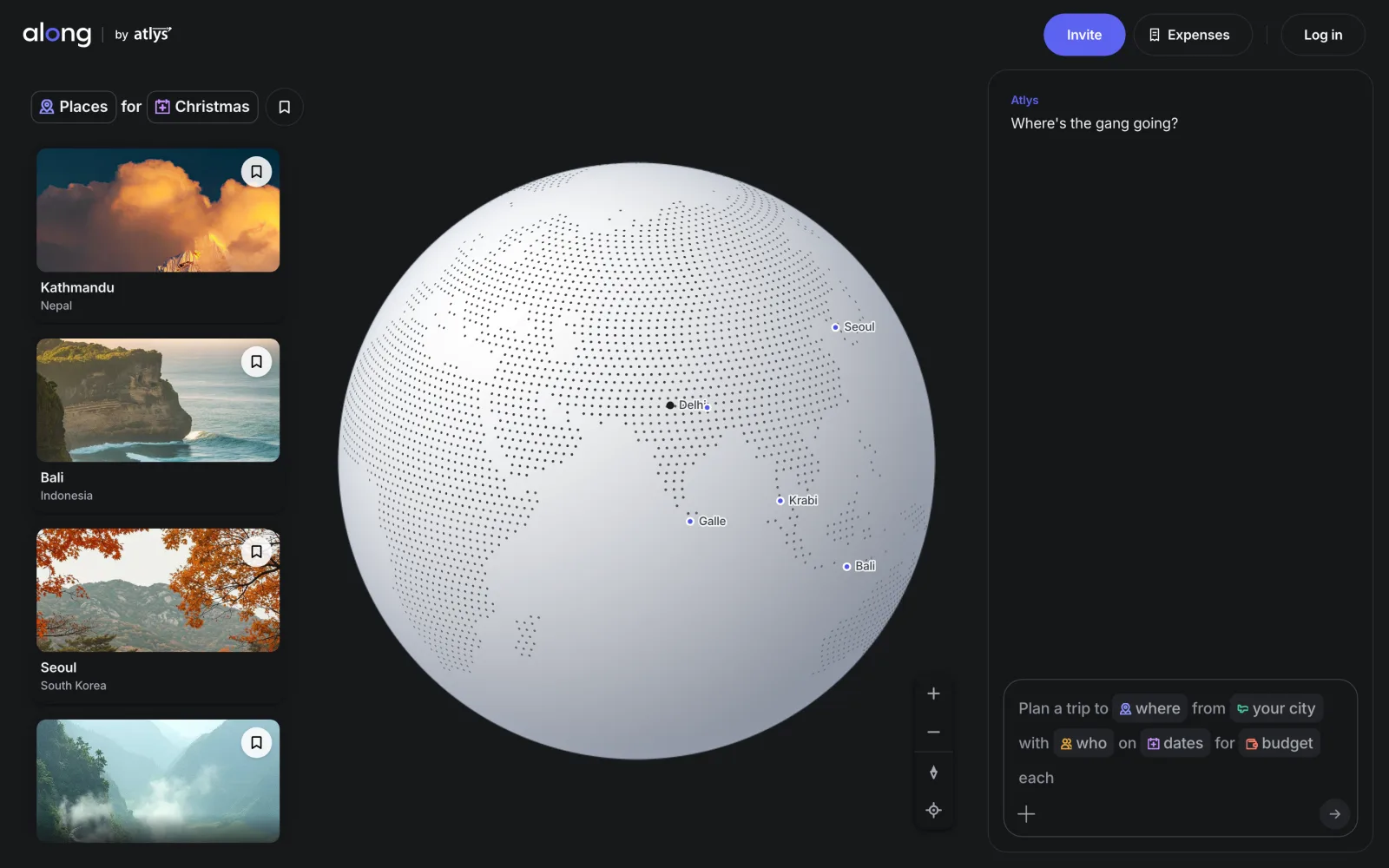
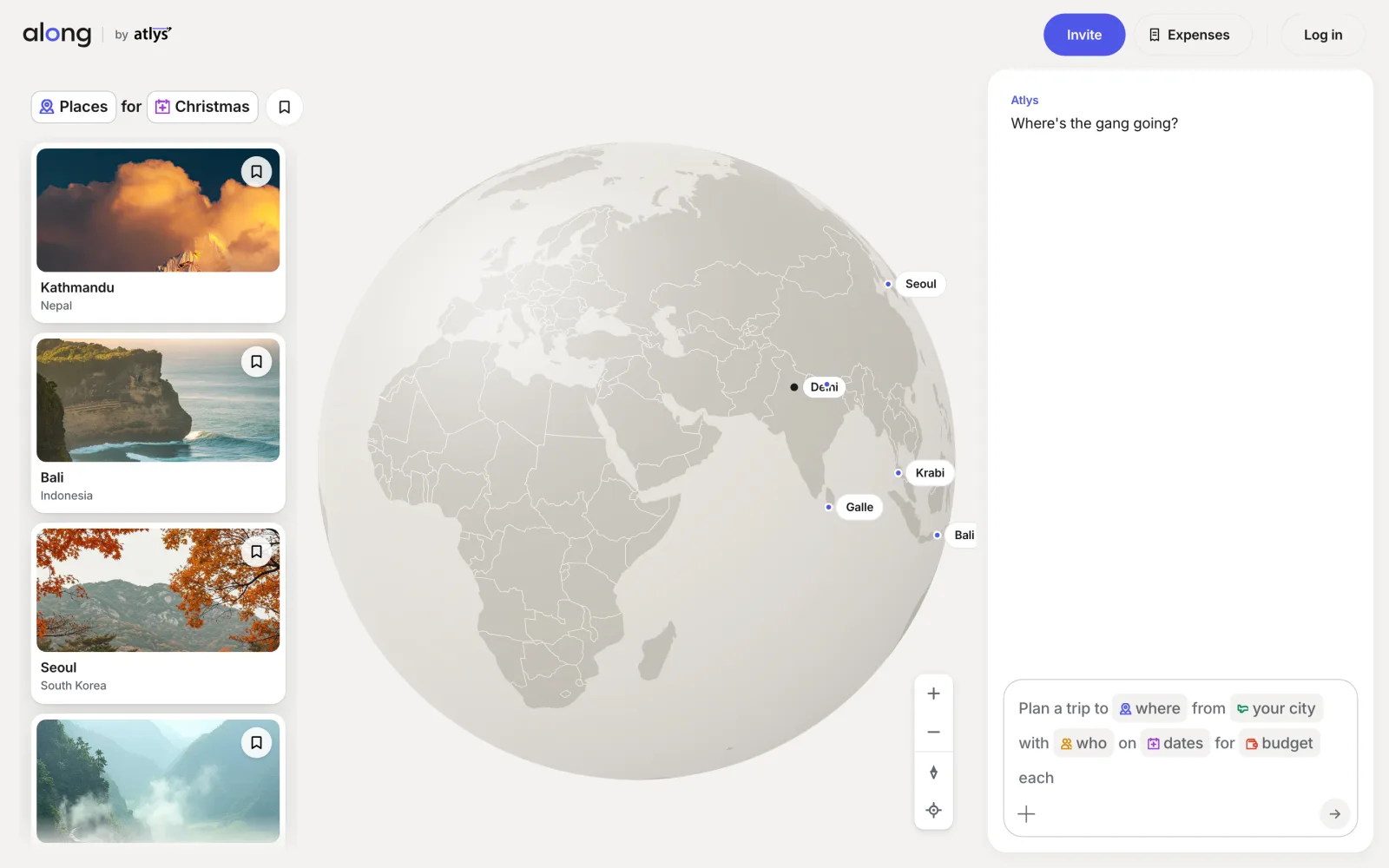
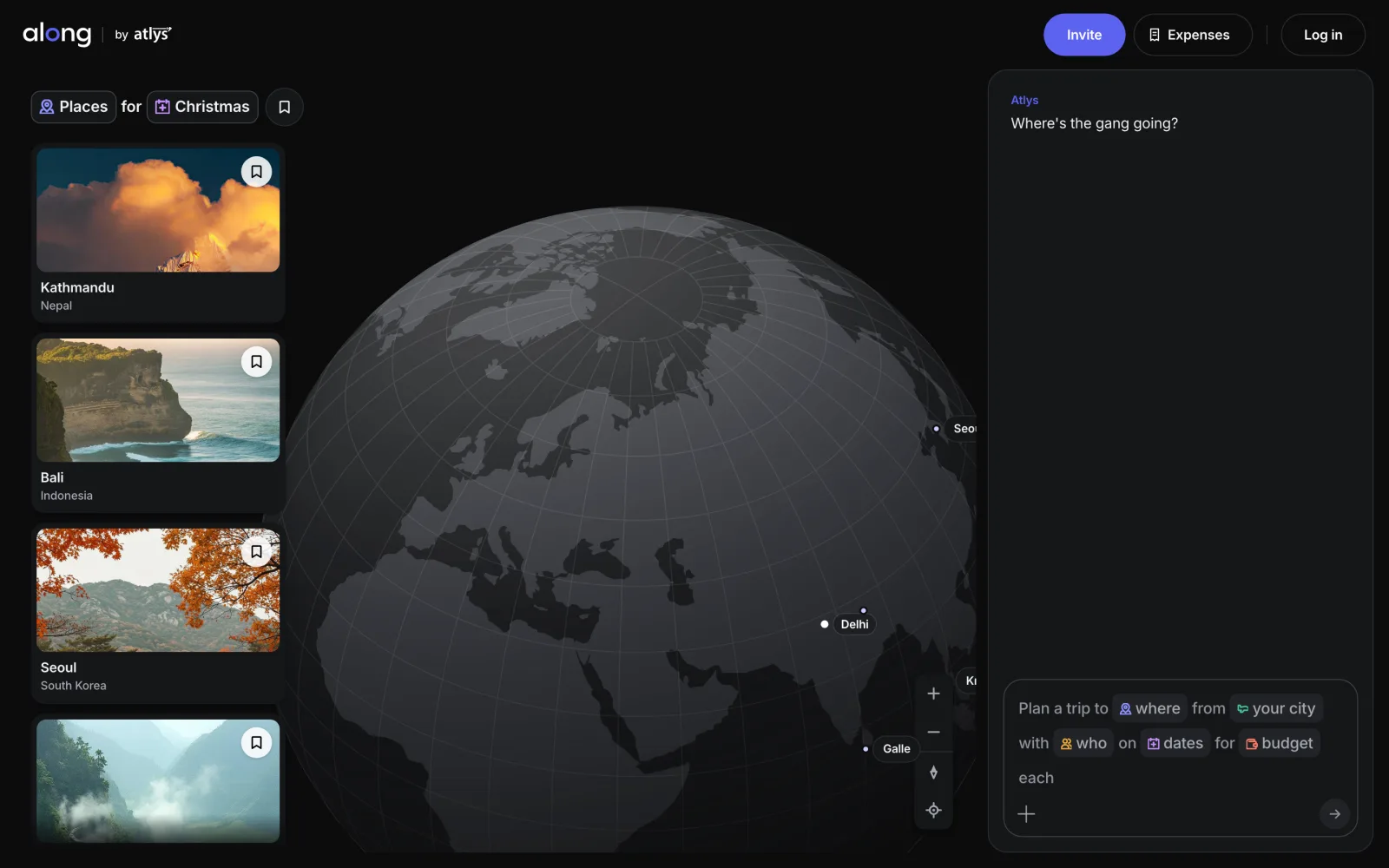
Final prototype
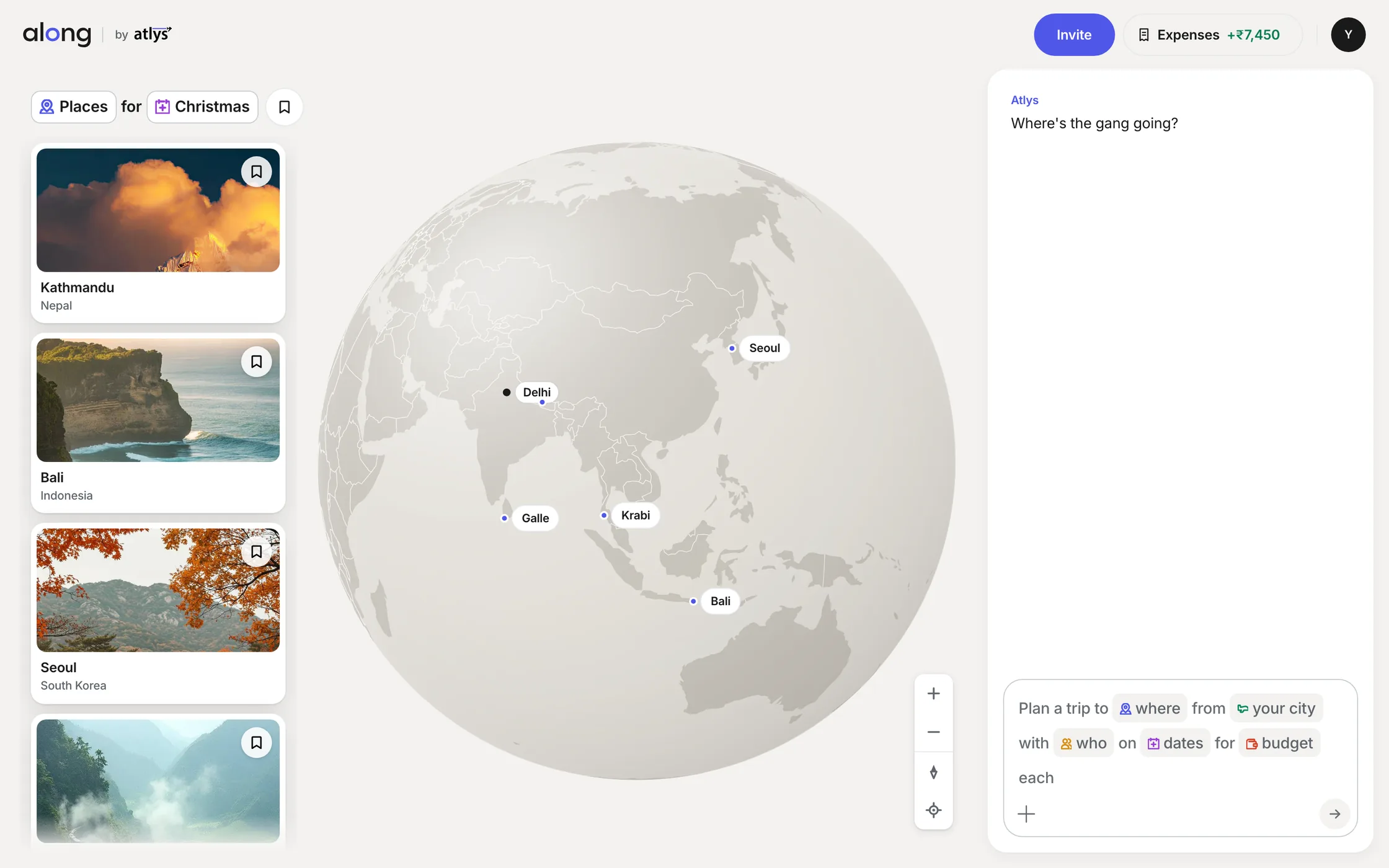
Key screens
Six screens from the final build.
Come back
Ideas on the globe
Tap a place and its card opens into a full plan.
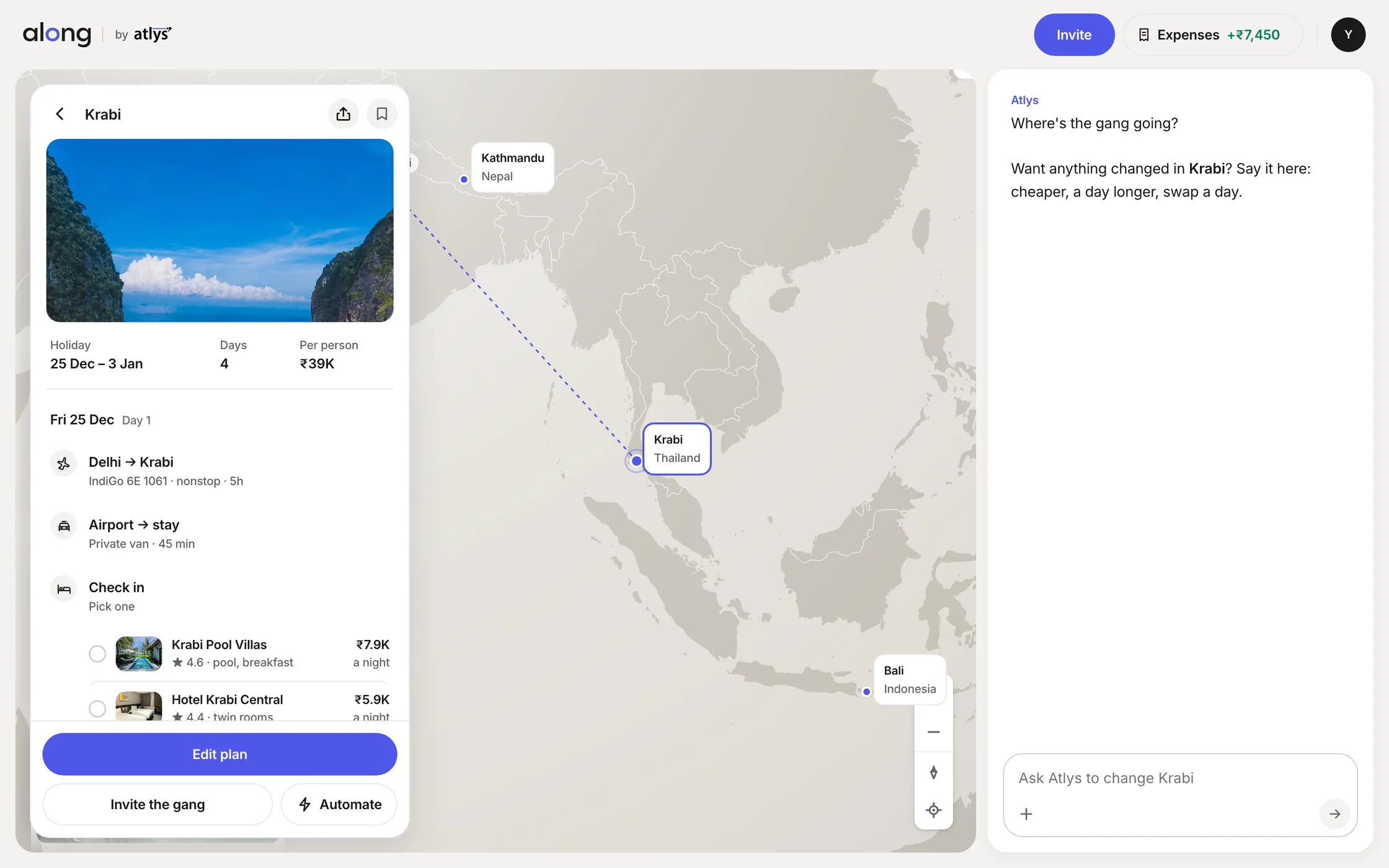
Plan
Change it by chat
Type “make it cheaper”. The plan updates, with Undo.
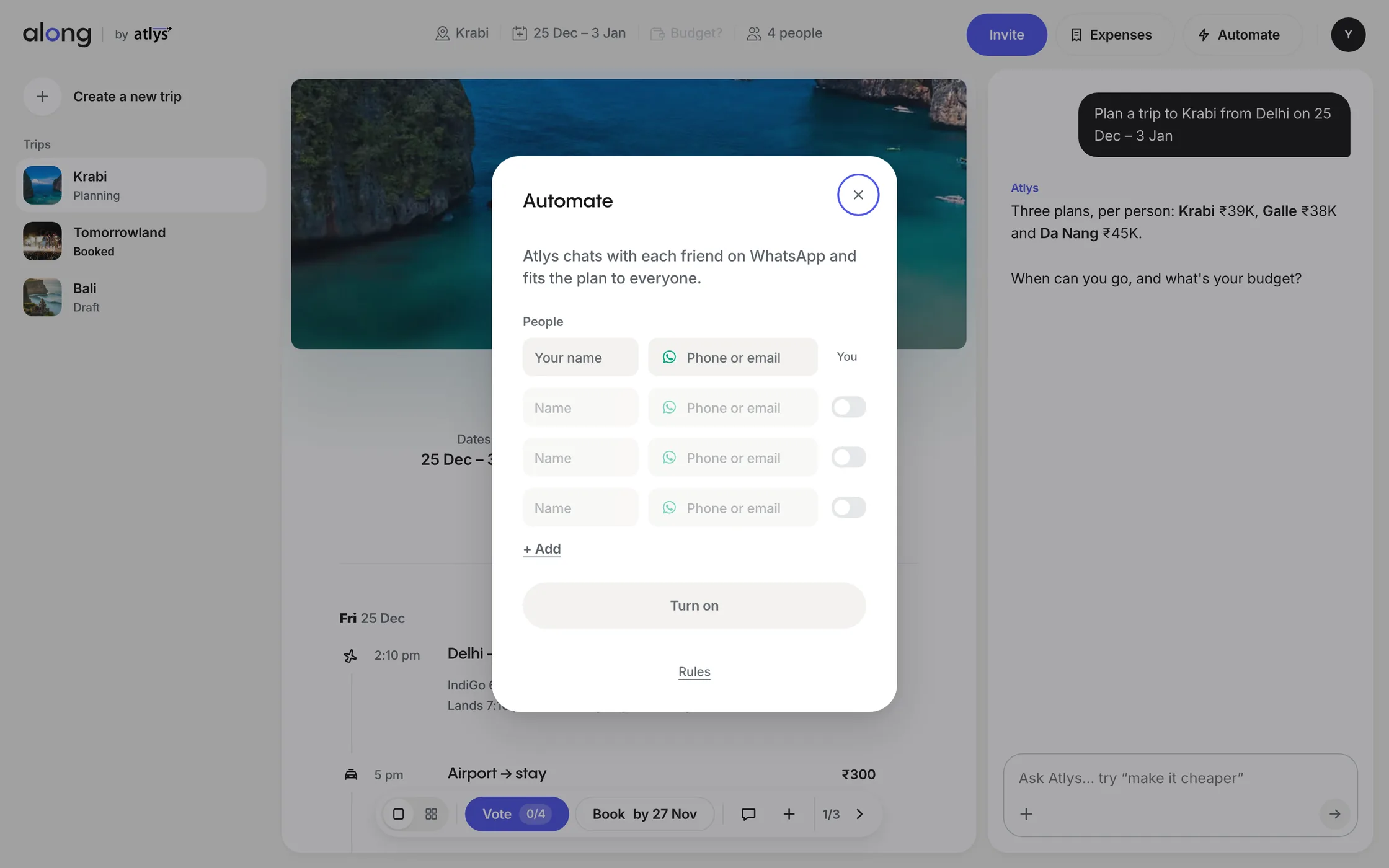
Plan
Agents chase for you
Atlys messages each person and fits the plan to everyone.
Book
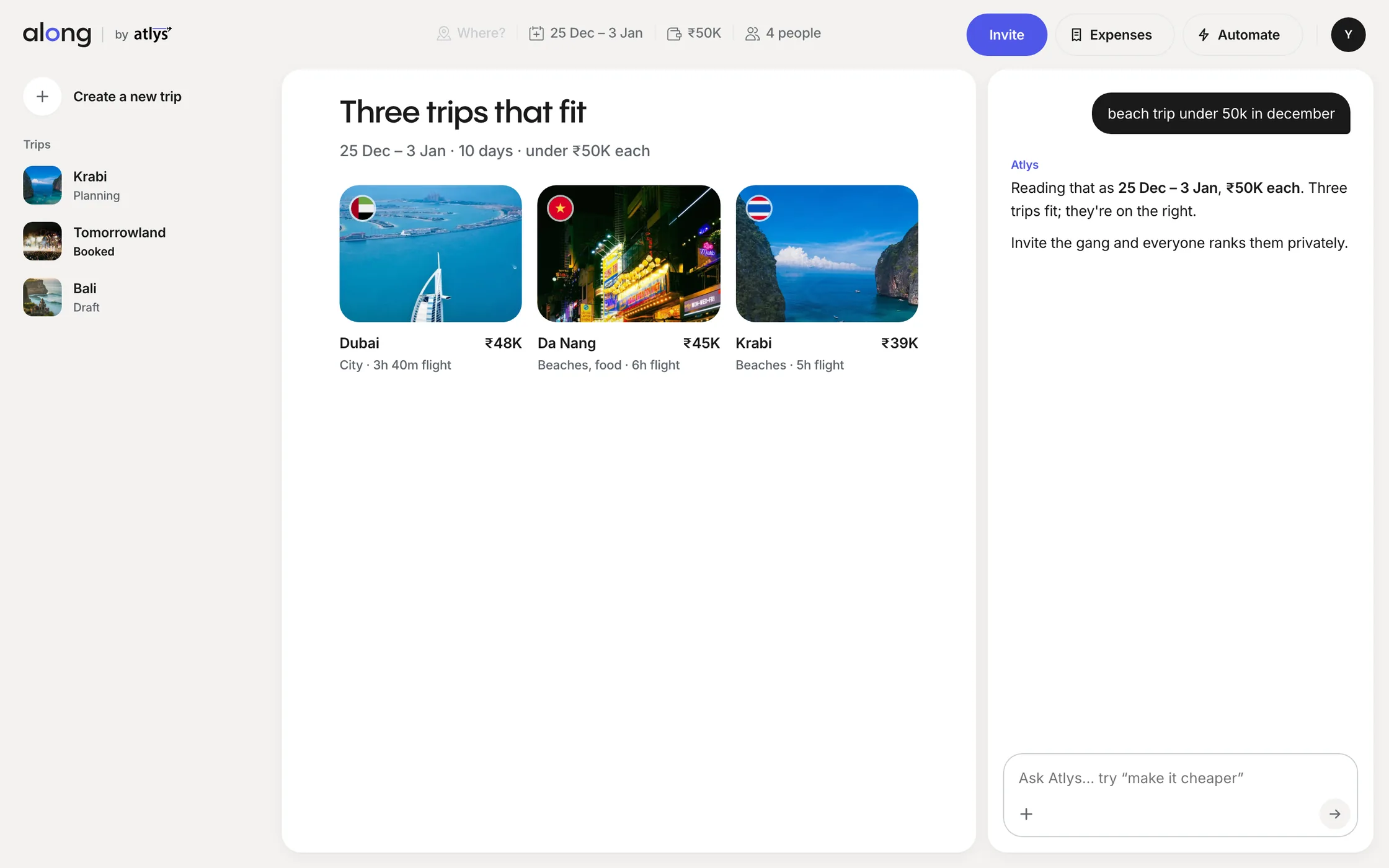
Plans side by side
Three whole trips, priced. Vote on one.
Book
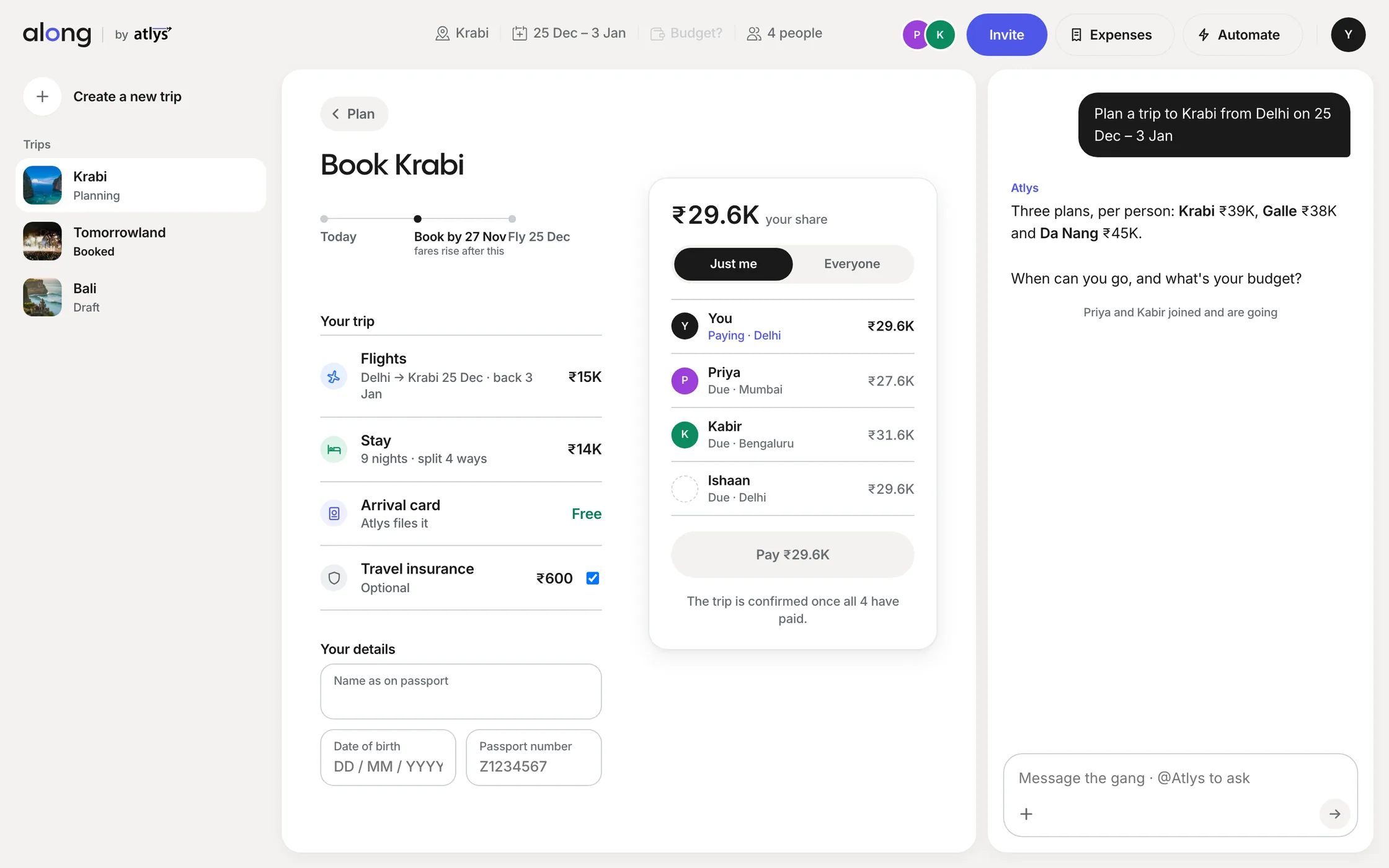
Pay your own share
Each person pays their part. That is the “I’m in”.
Discover
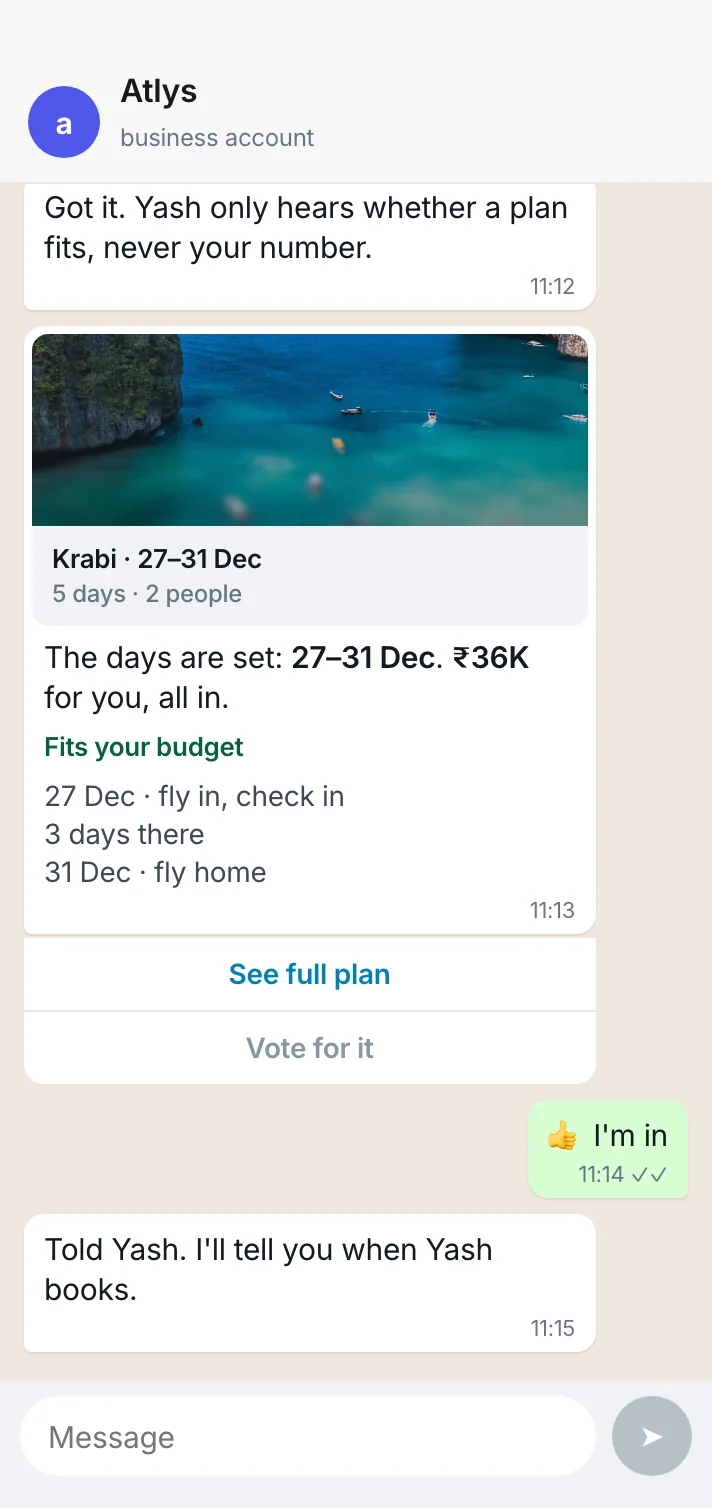
Join from WhatsApp
Tap the link, answer in the chat. No app.
What I expect it to do
This is what I’m expecting the design to do: the funnel a group trip goes through, which stage each growth lever moves, and the metrics I’m looking at. Everything here is my hypothesis. There is no data behind the funnel yet; the metrics are what I would measure.
Acquisition
Spark
Link shared
Acquisition
Invitees per trip
- Link opens → joins
- Invitees who later organise
- Trips per channel
Activation
2+ friends joined
Activation
Activated ÷ started
- Time to complete
- AI corrections
- Nudge → completion
Conversion
Group decided
Paid my share
Checked out
Conversion
Checked out ÷ started
- Decision rate and time
- Paid ÷ committed
- Dropouts after paying
Retention
Next trip
Retention
2nd trip rate
- Second trip within 6–12 months, by segment
- Time to the 2nd trip vs the 1st
Every trip is an invite
Invitees go on to start their own.
North star
Group trips checked out per week.
“I’m in” (now “paid my share”) is the leading indicator. A big drop at a stage means one of my bets there is wrong.
Guardrails
Nudge opt-outs and blocks, people skipping budget, members leaving after joining, AI corrections per trip, and organiser actions per trip (should fall).